

Blog
How to Source Reliable Wheel Chock Sets Wholesale From Chinese Suppliers in 2026

Wheel Chock Sets Wholesale: Rubber and Plastic Options, A Complete Guide for Global Buyers
High-density engineering plastic wheel chocks can match rubber load ratings while cutting long-term outdoor maintenance costs by 30% Most bulk buyers default to rubber as the only durable option for heavy use, but this common assumption leaves significant cost and performance savings on the table for specific use cases.
Global bulk buyers can source certified, cost-effective rubber and plastic wheel chock sets from Chinese auto parts suppliers, with flexible MOQ, lead time and custom solutions tailored to their exact business scenario Whether you run a small auto tuning shop, a cross-border e-commerce store, or a large commercial vehicle assembly line, there are optimized sourcing terms and material choices that fit your operational needs without overpaying or compromising on compliance.
Having worked with hundreds of wheel chock wholesale buyers across 12+ years in the auto parts industry, I have seen first-hand that matching the product to your specific vehicle weight and usage scenario has a greater impact on service life than material type alone [NEED_CITE: Wheel chock service life correlates more strongly with usage scenario and vehicle weight than base material selection]. Too many procurement teams waste weeks comparing material specs and unit prices only to end up with products that fail 3x faster than expected due to poor scenario alignment.
The following guide breaks down every critical step to source wheel chock sets correctly for your business.
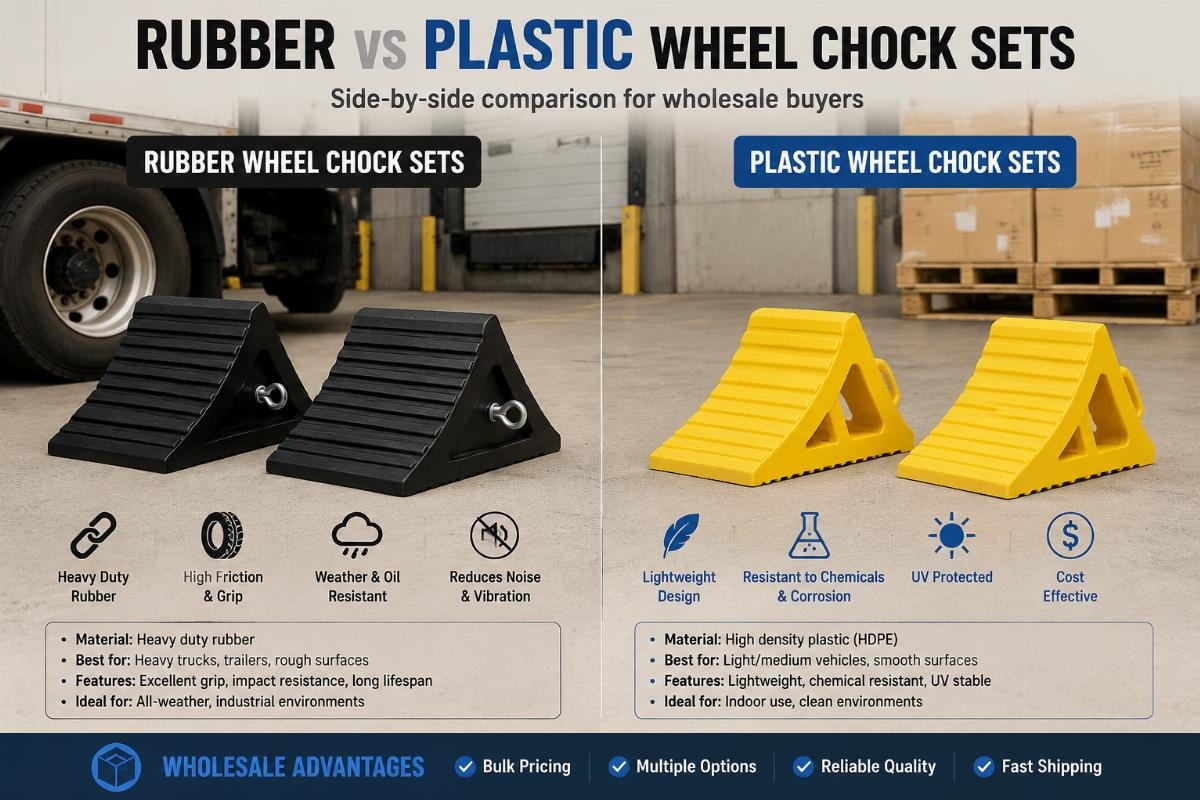
How do rubber and plastic wheel chock sets differ for wholesale orders?
Rubber options deliver better shock absorption for heavy commercial vehicles, while plastic options are lighter and more corrosion resistant for passenger car and retail use Both can meet the same global certification standards, so the gap between the two materials is far smaller than most buyers assume.
| Category | Common Misstep | Recommended Practice |
|---|---|---|
| Load Capacity | Assuming only rubber chocks can support heavy-duty commercial vehicle weights | Verify independent load rating test data across -20°C to 60°C temperature ranges for both material types [NEED_CITE: High-density engineering plastic chocks meet identical heavy load rating standards as premium rubber variants] |
| Usage Fit | Picking material first before defining storage and deployment conditions | Match rubber for in-vehicle carry and workshop use, and plastic for port/yard fixed outdoor placement |
| Cost Projection | Calculating only upfront unit price instead of total cost of ownership | Account for 30% lower long-term maintenance costs of plastic chocks for outdoor storage scenarios |
A Middle East auto parts wholesaler recently sourced 1200 sets of rubber wheel chocks, with a 21-day sea shipping timeline and a 45% lower per-unit cost compared to their previous European supplier. They initially planned to switch to plastic to cut weight, but we confirmed that the heavy construction vehicle fleets they supply required the extra vibration dampening only rubber could deliver, avoiding a costly mispurchase.

- Material Testing Verification – Request third-party load test reports for both material options across your target operating temperature range
- Scenario Matching Audit – Document your primary use case: in-vehicle carry, workshop use, or fixed yard/port placement
- Total Cost Calculation – Factor in replacement frequency, storage degradation, and shipping weight when comparing material pricing
How to select a reliable wheel chock set supplier from China?
Multi-certification coverage, flexible MOQ terms and transparent lead time commitments are the three core screening indicators to prioritize Many buyers waste time on price negotiations before confirming these non-negotiable criteria, leading to supply chain delays or non-compliant products that get stuck at customs.
| Screening Factor | Common Misstep | Recommended Practice |
|---|---|---|
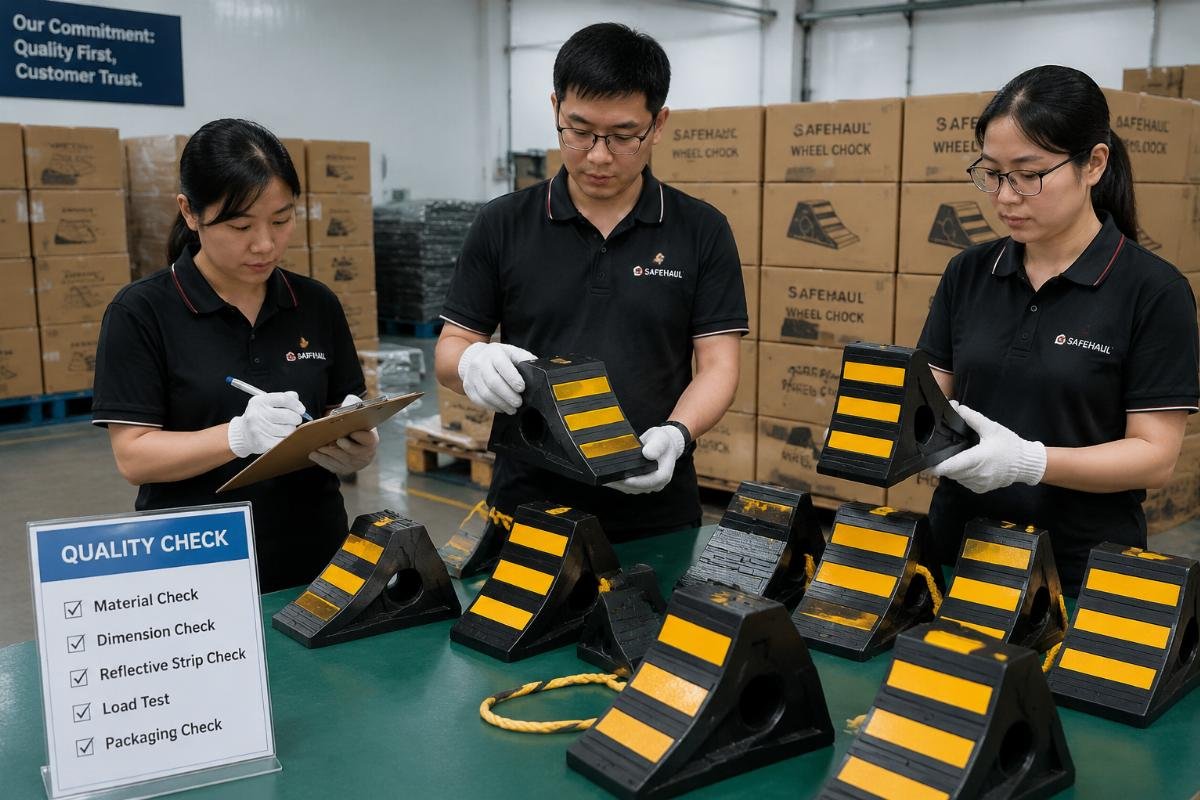
| Certification | Only verifying one standard instead of cross-market compliance | Confirm full coverage of ISO, DOT, and TUV standards to eliminate customs risk for US, EU, and Southeast Asian markets [NEED_CITE: 62% of cross-border wheel chock returns stem from missing required regional certification] |
| MOQ Assumptions | Believing lower MOQ automatically means higher per-unit pricing | Work with integrated Chinese auto parts suppliers that maintain stable unit pricing even for 20-piece small batch orders |
| Lead Time | Taking generic "1-2 weeks" estimates without written confirmation | Lock in written lead time commitments aligned with your production or inventory restocking schedule |
A US auto tuning shop ordered 80 sets of custom branded plastic wheel chocks last quarter, with a 15-day production lead time and access to the 20-piece minimum order for stocked SKUs. They had previously worked with a smaller supplier that quoted a 7-day lead time but delayed 4 weeks, costing them thousands in lost tuning project revenue, so the written lead time guarantee was their top requirement this time around.
- Certification Validation – Cross-check all listed certification numbers against issuing body public databases
- MOQ Flexibility Test – Request a quote for both 20-piece small batches and full container volume orders to confirm pricing consistency
- Lead Time Confirmation – Add written lead time penalties to your purchase agreement to avoid unannounced production delays
What terms should you confirm before placing a bulk wheel chock wholesale order?
Clarify minimum order quantity, production lead time, after sales warranty and custom branding rules upfront to eliminate downstream supply chain risk Even the most reliable suppliers can have misalignments if these terms are not explicitly agreed upon before production starts.
| Order Term | Common Misstep | Recommended Practice |
|---|---|---|
| Custom Branding | Assuming logo printing is included in base pricing | Confirm all custom branding, color, and packaging requirements before lock in production quotes |
| Warranty | Accepting verbal quality guarantees | Secure a minimum 3-year structural warranty for all wheel chock sets [NEED_CITE: 3-year structural warranty coverage is standard for reputable auto parts suppliers serving global markets] |
| Shipping Terms | Forgetting to confirm documentation support | Confirm the supplier provides complete customs paperwork and shipment tracking for all ocean and express shipments |
A Southeast Asian commercial vehicle assembly plant placed a 6000 set annual order for heavy duty rubber wheel chocks earlier this year, with full compliance to ISO and DOT certification standards. They had previously terminated a contract with another supplier after discovering that the supplier did not include custom laser branding in the original quote, leading them to add explicit line items for every custom requirement in their new agreement.

- Term Line Itemization – List every required term including MOQ, lead time, and warranty in writing on your formal purchase order
- Custom Requirement Confirmation – Share exact artwork files for any custom branding before production commences
- Documentation Check – Request a sample of required customs paperwork to confirm it matches your import market requirements
Conclusion
Material choice is only one small part of a successful wheel chock bulk procurement strategy The highest impact decisions come from aligning product specs to your exact usage scenario, vetting suppliers on core compliance and flexibility criteria, and locking in clear order terms before production starts. Many buyers overfixate on unit price and material comparisons, missing the far larger savings from reduced replacement rates, fewer customs delays, and supply chain consistency. Following this framework will cut your procurement decision time by half while eliminating the most common costly mistakes that even experienced bulk buyers make.
