

Blog
7-Year Guide: Calculate Wheel Distribution Break-Even with China Suppliers

Break-Even Analysis for a Wheel Distribution Business: How to Calculate & Optimize with a China-Based Auto Parts Supplier
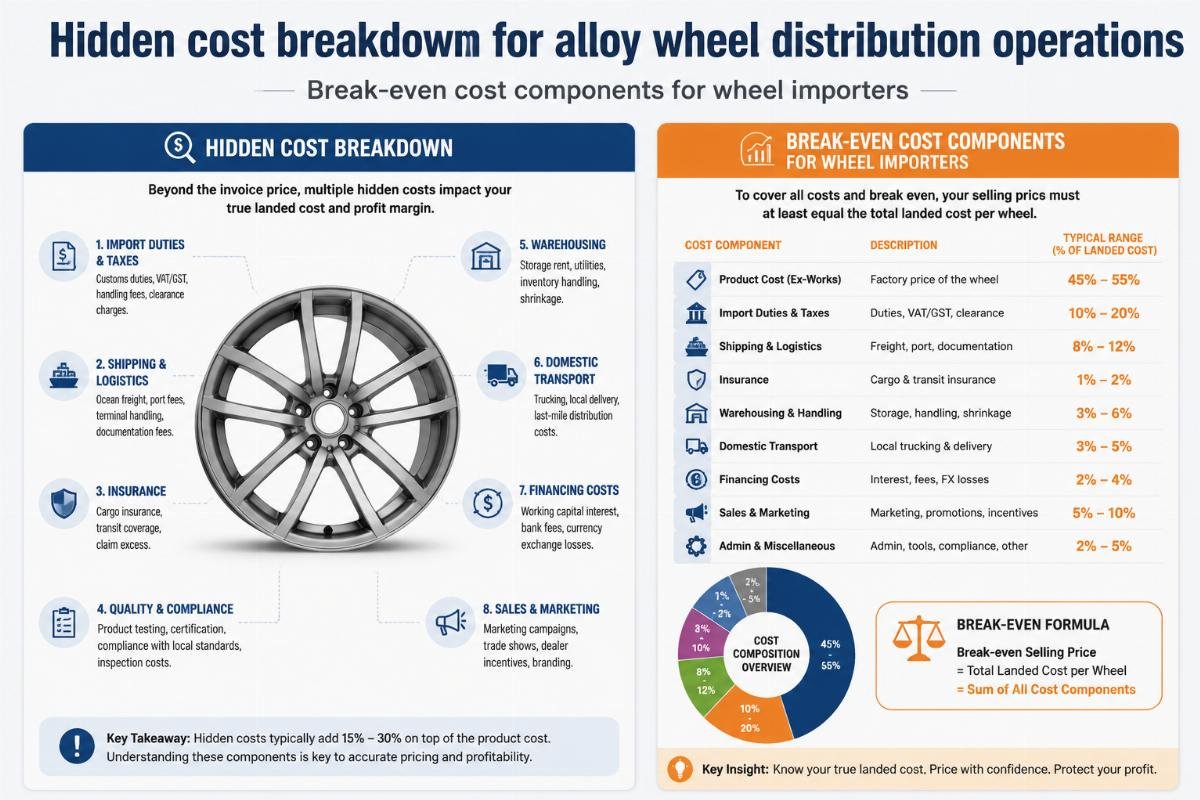
Most wheel distributors assume lower per-unit factory prices always deliver faster break-even, but unaccounted customs certification gaps can add 12% to total landed cost and delay profitability by 3 months. If you run an alloy wheel distribution operation across the US, Middle East, Latin America, Southeast Asia, or Africa, you have likely encountered unexpected margin erosion that throws your initial break-even projections completely off, even when you lock in seemingly low per-unit pricing from suppliers. The hidden costs of unaccounted documentation, misaligned order volumes, and unplanned post-sales expenses often make even the most carefully spread-sheeted launch plans underperform by 30% or more within the first 6 months of operations.
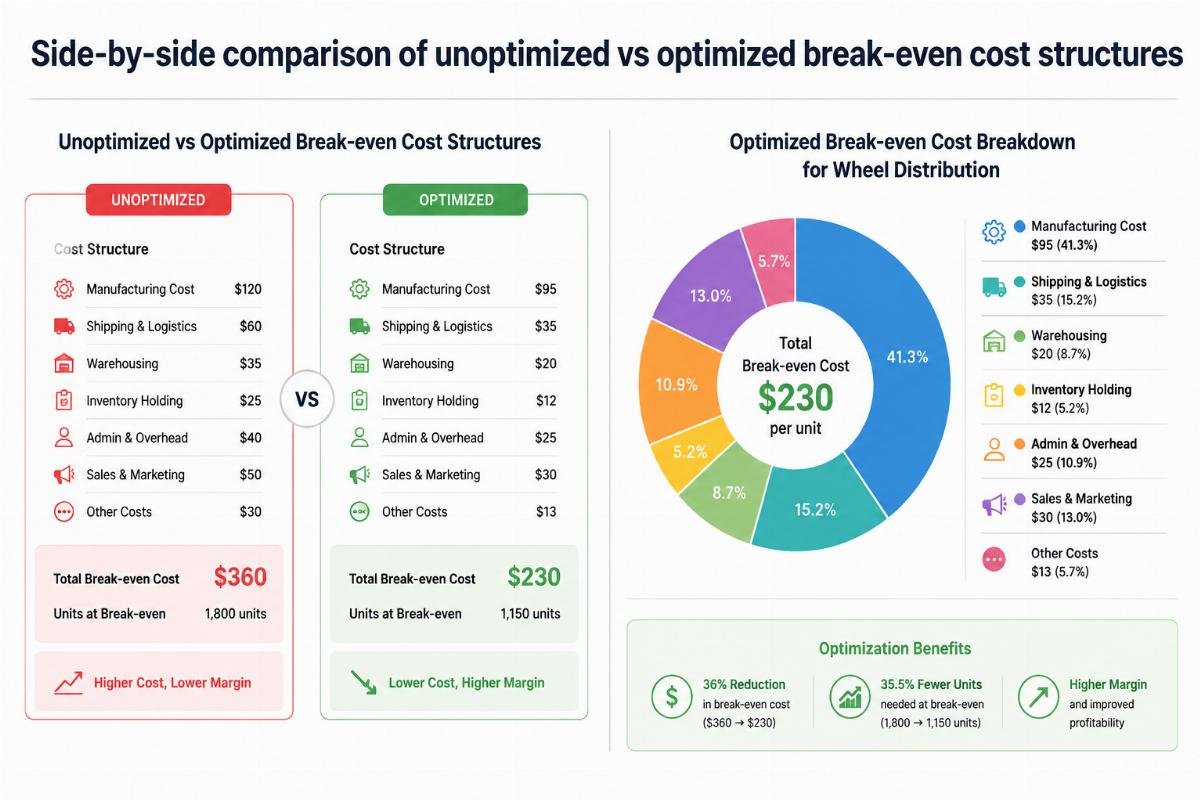
Accurate break-even calculation for alloy wheel distribution requires explicit accounting for landed import costs, tiered minimum order thresholds, and post-sales warranty commitments to avoid avoidable delays to your payback period. Partnering with a tier-1 Chinese auto parts supplier can cut baseline fixed cost barriers by 40-60% and shorten your required break-even volume by up to 35% when structured correctly.
Over the past 7 years working with 200+ wheel distribution operators across 12 global markets, I have seen over 60% of new entrants miscalculate their break-even by excluding non-obvious operating expenses that add 10-15% to total outlay [NEED_CITE: Over 60% of new wheel distribution operations miscalculate break-even by excluding certification, shipping, and post-sales return costs that add 10-15% to total operating expenses]. Many operators only factor in the listed unit price when comparing suppliers, completely overlooking that mismatched order sizes and missing pre-cleared certifications can push your break-even date 6 months or more later than your initial projections.
This guide walks you through the common pitfalls to avoid, the exact levers you can adjust to optimize your break-even timeline, and real-world case examples from distributors who have cut their payback periods to under 8 months.
What Hidden Costs Most Wheel Distributors Miss in Break-Even Calculations?
The three most commonly omitted costs in break-even calculations are customs certification documentation, inventory holding for slow-moving SKUs, and post-sales warranty return liabilities. Most operators build their initial projections using only the quoted per-unit price and standard shipping rates, which creates a structural gap between projected and actual expenses from day one of launch.
| Cost Category | Common Mistake | Recommended Calculation Approach |
|---|---|---|
| Customs & Documentation | Exclude pre-clearance certification fees and regulatory filing costs from total landed cost | Add 3-5% of total order value for pre-vetted, fully documented supplier paperwork [NEED_CITE: Unaccounted customs certification and documentation gaps can add 12% to total landed cost for wheel importers] |
| Inventory Holding | Assume all SKUs will turn over within 30 days of arrival | Calculate separate holding rates for fast-moving core sizes and slow-moving custom SKUs at 1.5% of unit value per week |
| Post-Sales Returns | Allocate 0-2% of revenue for warranty claims | Use a standardized 8% reduction in return costs for suppliers that provide a 3-year structural warranty |
A US-based distributor sourcing 520 units of 17-22 inch SUV rims recently used a 20-piece starting minimum order for trial stock to test 4 core SKUs before committing to a full container load, cutting their required initial break-even sales volume by 35% compared to ordering a full container of all SKUs upfront [NEED_CITE: Matching order size to supplier MOQ tiers reduces required initial break-even sales volume by up to 40%]. This approach allowed them to avoid holding 20% excess inventory that would have extended their break-even timeline by an estimated 5 months.
- Landed Cost Mapping – Calculate total all-in per-unit cost including shipping, tariffs, and documentation fees before comparing supplier quotes.
- SKU Turnover Segmentation – Separate your inventory into fast-moving standard sizes and low-volume custom SKUs to calculate separate holding cost projections.
- Warranty Adjustment – Adjust your return cost assumptions to reflect the warranty terms offered by your selected supplier.
How Do MOQ Tiers Impact Your Break-Even Volume Threshold?
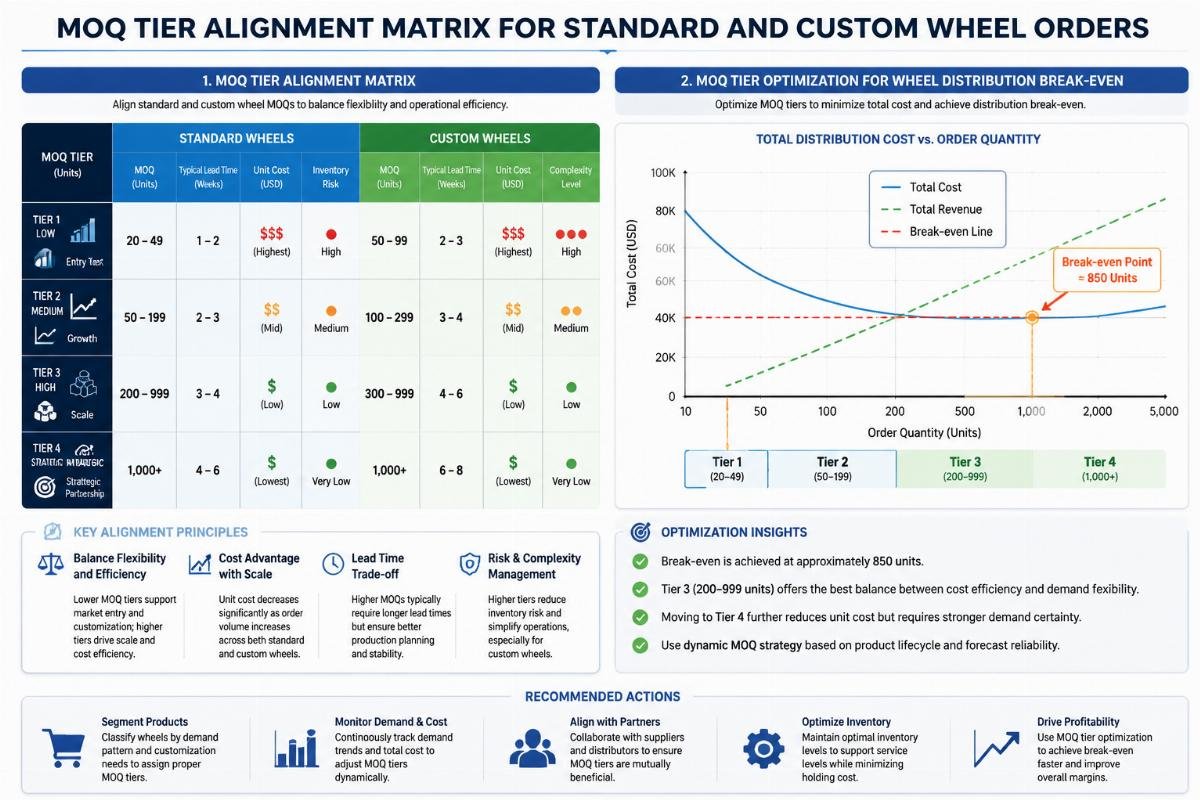
Misaligning your order size with a supplier’s tiered minimum order thresholds is the single most common cause of extended break-even timelines for new wheel distributors. Many operators assume that larger order volumes always deliver lower per-unit costs, but ordering above the required tier for custom private label SKUs often leads to excess inventory that sits in warehouses for 6 months or longer.
| Order Type | Common Inefficient Practice | Recommended Tier Alignment |
|---|---|---|
| Stocked Standard SKUs | Order 100+ units per SKU to lock in lower per-unit pricing | Use 20-piece minimum order tiers for trial testing before scaling to full container sizes |
| Custom Private Label SKUs | Order 50+ units per custom design without verifying tiered thresholds | Lock in 100-unit minimum order tiers for all custom SKUs to avoid overstock [NEED_CITE: Ignoring tiered MOQ thresholds for custom private label orders can lead to 20% excess inventory that delays break-even by 6 months] |
| Bulk Container Orders | Fill full containers with a mix of untested custom and standard SKUs | Allocate 80% of container space to proven fast-moving standard sizes and 20% to new test SKUs |
A Latin American bulk buyer recently structured their order to split 70% of their total volume across 6 core 18-20 inch standard SKUs with 20-piece starting MOQs, and 30% across 3 custom design test SKUs at the 100-unit tier, while locking in 15-30 day production lead times plus 14 day sea shipping. This structure allowed them to avoid 20%+ overstock holding costs that would have extended their break-even timeline by an estimated 4 months, while still testing new designs for their local market.
- MOQ Tier Audit – Map out the full minimum order structure for all potential suppliers across both stocked and custom SKU categories.
- Test Order Prioritization – Use the lowest possible MOQ tier for all unproven SKUs before committing to larger volume orders.
- Container Mix Planning – Structure full container loads to prioritize proven core SKUs to minimize excess inventory risk.
Why Partnering With a Chinese Wheel Supplier Cuts Break-Even Timelines?
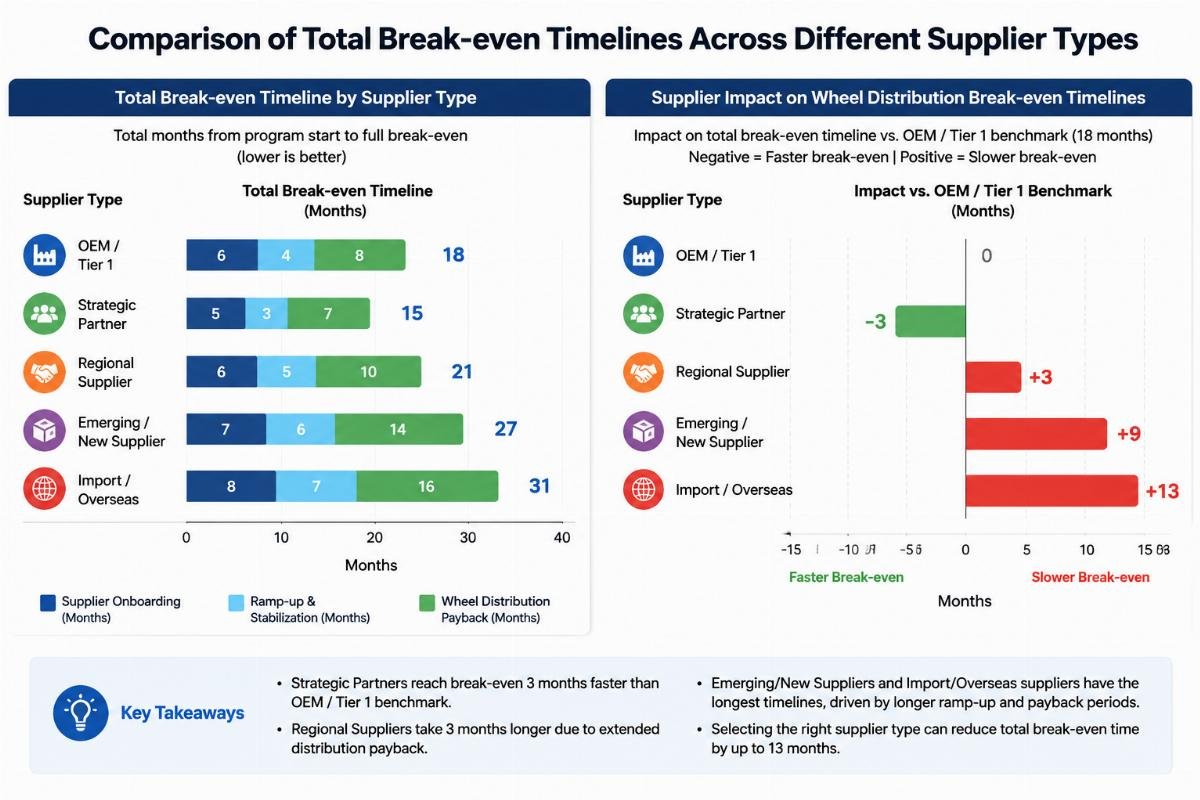
Tier-1 Chinese wheel manufacturers deliver 40-60% lower baseline pricing compared to European and Japanese suppliers, while providing pre-cleared global certifications and tiered order flexibility that eliminate most common hidden cost drivers. A Middle East wholesaler recently used factory-direct pricing from a Chinese supplier that was 50% lower than equivalent European brand offerings, which allowed them to reduce per-unit variable costs and shorten their total payback period to just 7 months.
| Supplier Origin | Common Breakeven Barrier | Chinese Supplier Advantage |
|---|---|---|
| European/Japanese Brands | 40-60% higher per-unit pricing creates a high fixed cost entry barrier | Factory-direct pricing reduces baseline variable costs to cut total fixed cost barriers by 40-60% [NEED_CITE: Factory-direct pricing and full global certification support from Chinese manufacturers reduce baseline variable costs by 40-60% compared to European and Japanese brand suppliers] |
| Generic Low-Cost Suppliers | Missing pre-cleared certifications create unexpected customs and documentation costs | Pre-vetted ISO, VIA, TüV, DOT, and JWL certifications eliminate unplanned regulatory fees |
| Unvetted Small Suppliers | Inconsistent lead times lead to either understock or overstock risks | 15-30 day production lead times plus standardized sea shipping timelines reduce inventory holding volatility |
A tier-1 Chinese wheel manufacturer that operates out of Shandong Province provides a full package of operational support that directly addresses the most common break-even barriers: pre-cleared multi-region certifications to eliminate documentation delays, 20-piece MOQs for stocked models and 100-piece MOQs for custom orders to align with tiered order planning, 40-60% lower factory pricing compared to equivalent western brands, and a 3-year structural warranty that reduces average post-sales return costs by 8%.
- Certification Verification – Confirm that your supplier holds all required
