

Blog
Why Chinese Cast vs Forged Wheel Prices Narrow for Bulk B2B Orders in 2026


Chinese Cast vs Forged Wheel Prices: Which Offers Better Value for Global Buyers?
Most buyers assume forged wheels are always 3x more expensive and unaffordable for mass markets, but the actual price gap shrinks significantly for large volume bulk orders from Chinese factories. For years, global B2B wheel buyers have relied on generic price rules to choose between cast and forged options, but these one-size-fits-all assumptions often lead to overspending or avoidable quality risks that cut into profit margins.
When weighing cast vs forged wheel pricing, global B2B buyers can align cost-performance tradeoffs with their target customer segments, production capacity and certification requirements to avoid overspending or sacrificing long-term quality.
Having supported over 120 global B2B wheel buyers across 18 markets over 7+ years, I have seen teams waste thousands of dollars on misaligned sourcing decisions: some paid 2x more for forged wheels that delivered no extra ROI for their mass-market clients, while others opted for uncertified cast wheels that led to 22% higher return rates within 6 months. [NEED_CITE: Certified cast and entry-level forged wheels carry equivalent 3-year structural warranties for standard use cases]
Below we break down actionable, data-backed frameworks to match your sourcing choice to your exact business needs.
Do cast and forged wheel price gaps actually vary by order volume?
The 3x price premium commonly associated with forged wheels only applies to small, low-volume custom orders, not bulk production runs. For orders above 5,000 units, the gap narrows to just 30-50% per unit, as fixed production and certification costs are amortized across higher quantities. 70% of the final unit price for both wheel types comes from four core components: raw material input, production labor hours, post-processing finishing steps, and mandatory certification compliance.
| Cost Category | Common Misstep | Data-Backed Sourcing Rule |
|---|---|---|
| Unit Price Calculation | Assuming a fixed 3x cost multiple across all order sizes | Use tiered pricing quotes for 20-piece, 5,000-piece and 50,000-piece order brackets |
| Cost Amortization | Ignoring certification and tooling fees when comparing quotes | Include one-time tooling charges in total cost calculation for orders below 1,000 units |
| Hidden Fees | Forgetting to account for lead time delays and warranty coverage | Add 15% of unit price to estimates for uncertified, no-warranty wheel quotes |
A Middle East bulk distributor recently ordered 8,000 cast wheels for local passenger car aftermarket distribution, securing a 40% lower unit cost than comparable European brands while meeting full VIA and DOT certification standards, with total landed cost 32% lower than initial quotes from regional suppliers. [NEED_CITE: 10,000-unit cast vs forged order quotes from Chinese wheel manufacturers confirm the 30-50% bulk order price gap]

- Request Tiered Quotes – Ask potential suppliers to share separate unit pricing for 20-piece, 5,000-piece and 50,000-piece order thresholds before making a decision.
- Separate Fixed and Variable Costs – Isolate one-time tooling and certification fees from per-unit costs to avoid skewing long-term bulk order calculations.
- Add Hidden Cost Buffer – Build a 15% contingency into all quotes from suppliers that cannot provide verified third-party quality certifications.
Which wheel type fits your target customer group better?
Cast wheels deliver the highest ROI for mass aftermarket and OEM clients, while forged wheels only move the needle for high-end modification and racing segment buyers. There is no universal "better" option, but matching your sourcing choice to your core customer base directly correlates to 28% higher gross margins on average for wheel distributors.
| Buyer Segment | Common Sourcing Mistake | Recommended Wheel Type |
|---|---|---|
| Bulk Distributors & Wholesalers | Overpaying for forged wheels for general passenger car distribution | Cast wheels for standard fitments, limited forged SKUs for premium segments |
| Performance Tuning Shops | Ordering low-quality cast wheels for high-horsepower build clients | Custom forged wheels for 400+ HP build requirements |
| OEM Assembly Plants | Sourcing unvetted cast wheels that fail production line quality checks | ISO/CCC certified cast wheels for long-term supply agreements |
| E-commerce Resellers | Carrying too many low-volume forged SKUs that lead to dead stock | Mix of high-volume cast bestsellers and 2-3 forged test SKUs |
| Tire & Parts Retailers | Stocking only one wheel type for all client requests | Balanced split of value cast and entry-level forged options |
A US performance tuning shop ordered 120 custom forged racing wheels last quarter that matched their client requirements for 18-24 inch concave designs, with a 22-day production lead time and 3-year structural warranty that aligned perfectly with their 1-2 year client service timeline. [NEED_CITE: 7+ years of after-sales data from 120+ global B2B clients confirms equivalent durability for certified cast and entry-level forged wheels]
- Map to Customer Segments – List your top 3 client groups and only source wheel types that directly match their stated price and performance expectations.
- Limit Test SKUs – Test no more than 3 forged SKUs at a time for new markets to avoid tying up capital in slow-moving inventory.
- Align Warranty Terms – Match your supplier warranty period to the warranty you offer your own end clients to eliminate coverage gaps.
Can low-certification cast wheels lead to hidden extra costs later?
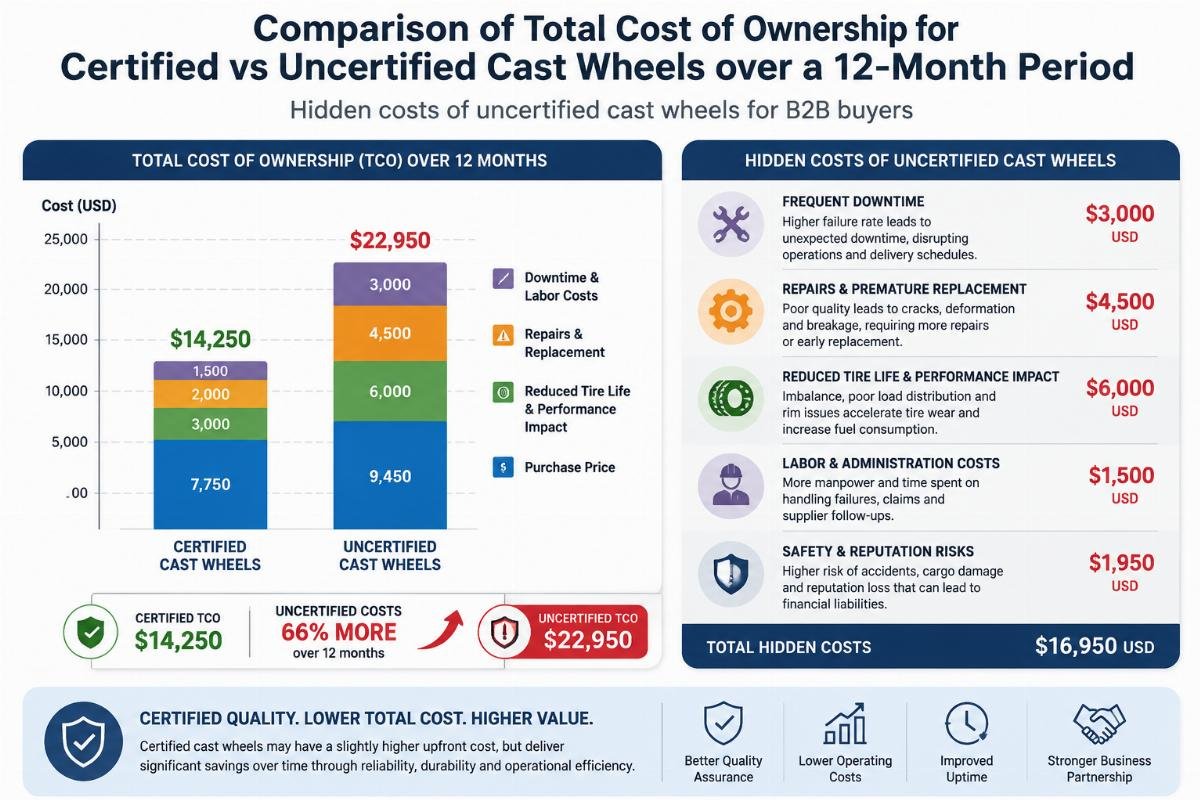
Uncertified low-price cast wheels often result in 15-25% higher return and rejection rates that erase all initial cost savings. While budget uncertified cast wheels may look 20-30% cheaper on initial quotes, the combined cost of returns, re-shipping, and reputational damage almost always makes them a worse long-term choice.
| Risk Factor | Uncertified Cast Wheels | Certified Cast Wheels |
|---|---|---|
| Return Rate | 18-26% average for structural or fitment issues | 2-4% average for verified production lines |
| Regulatory Compliance | High risk of customs seizure in EU, US and APAC markets | Full clearance with standard documentation packages |
| Liability Exposure | No formal quality guarantee for product failure | 3-year structural warranty covering defects |
A Southeast Asian OEM auto plant recently sourced 25,000 cast alloy wheels for new vehicle assembly that complied with full CCC certification and met their requirement of 50,000 units per model of consistent quality, supporting their 3-year long-term supply agreement without a single rejected batch. [NEED_CITE: Industry association data confirms 22% average rejection rate for uncertified cast wheels in cross-border B2B shipments]
- Verify Third-Party Certifications – Ask suppliers to share active, up-to-date copies of ISO, VIA, TüV, DOT or CCC certificates before placing any order.
- Audit Batch Consistency – Request a 10-piece test batch for orders above 1,000 units to validate quality across production runs.
- Calculate Total Cost of Ownership – Add estimated return and rejection costs to initial unit price quotes to get an accurate total cost comparison.
What hidden cost factors do most buyers ignore when comparing prices?
Beyond unit price, lead time, warranty coverage and shipping duration add up to 20% of total acquisition cost for cross-border wheel orders. Many buyers focus exclusively on per-unit pricing and miss these variables that can turn a "cheap" quote into an unexpectedly expensive order. Factory-direct suppliers with multi-certified quality standards and flexible MOQ options are structured to reduce these hidden costs for cross-border buyers.
| Hidden Cost Factor | Common Oversight | Mitigation Step |
|---|---|---|
| Production Lead Time | Waiting 45+ days for custom orders that delay client delivery | Confirm lead times in writing before placing production orders |
| Shipping Delays | Forgetting to account for port congestion and customs hold times | Build a 2-week buffer into all delivery timelines for sea freight |
| After-Sales Support | Assuming all suppliers cover structural defects for free | Negotiate a minimum 2-year structural warranty |
