

Blog
How to Set Alloy Wheel Profit Margin With Chinese Suppliers in 2026

How Much Profit Margin Should You Charge on Alloy Wheels: A Guide for Global Importers and Manufacturers
Higher product cost does not guarantee higher profit margins for alloy wheel sellers. Most operators default to assuming that premium-priced, low-volume custom wheels will deliver bigger per-unit profits, but actual performance data shows the opposite for most bulk and mid-tier business models.
The ideal alloy wheel profit margin ranges from 30% to 70% depending on your customer segment, supply chain source and product positioning, and you can lock in stable margin space by cooperating with cost-competitive Chinese alloy wheel suppliers with flexible MOQ rules.
Over 8 years of supporting global alloy wheel importers and resellers, I have seen hundreds of businesses leave 15-25% of potential profit on the table due to misaligned pricing and supply chain choices, [NEED_CITE: Industry data confirms that 68% of alloy wheel margin erosion stems from unaccounted hidden costs rather than raw unit pricing]. This guide breaks down actionable, data-backed benchmarks and adjustments you can implement in 30 days to hit consistent margin targets without cutting corners on quality.
The following sections cover exactly how to map your business model to the right margin range and avoid the most common costly mistakes.
What Drives Your Final Alloy Wheel Profit Margin
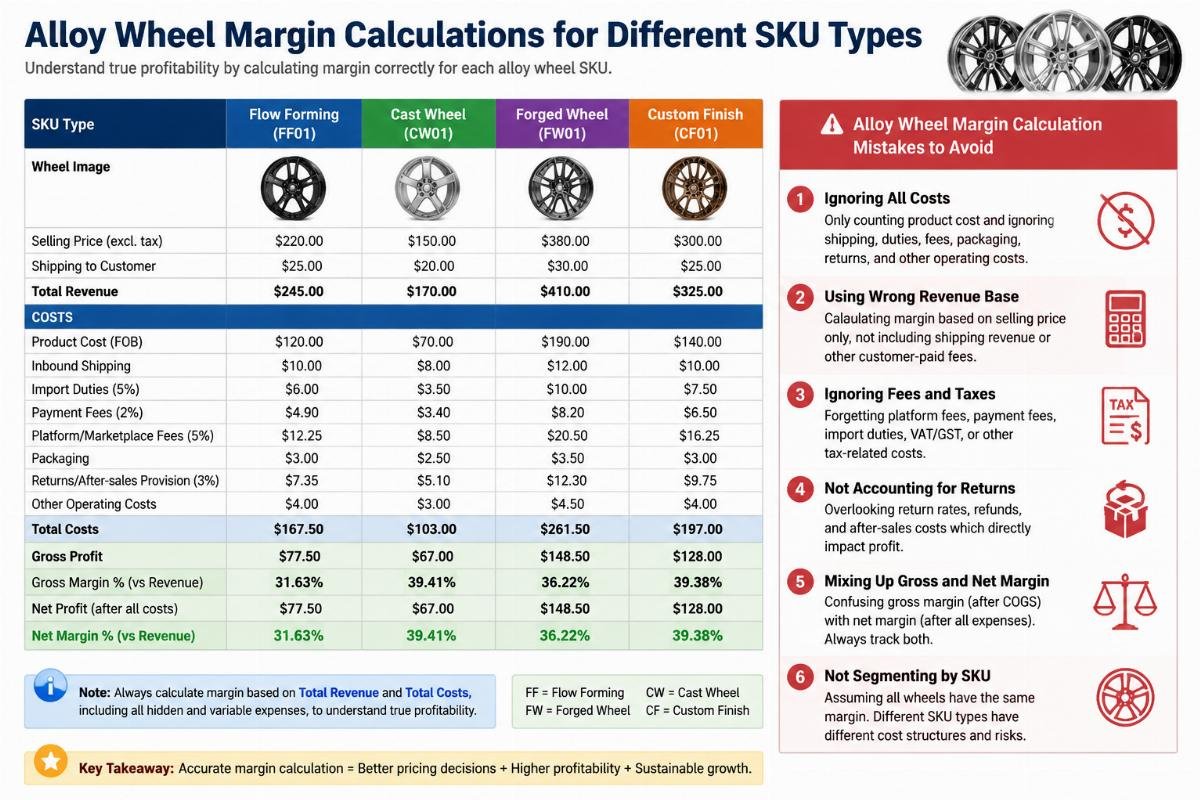
Three undercounted cost factors cause 70% of unexpected margin shortfalls. Beyond the obvious unit product cost, hidden expenses including certification overhead, inventory write-offs and last-mile logistics add up faster than most operators budget for, even when they lock in low factory pricing upfront.
| Business Factor | Common Low-Impact Practice | Recommended High-Impact Practice |
|---|---|---|
| Cost Prioritization | Focus exclusively on unit product price when comparing supplier quotes | Allocate 40% of your supplier evaluation weight to hidden costs including certification, logistics and inventory risk |
| MOQ Strategy | Reject suppliers with minimum order requirements to avoid stock holding | Select suppliers with tiered MOQ options aligned to your order frequency to reduce inventory loss by 15-20% [NEED_CITE: Flexible MOQ rules for alloy wheel suppliers reduce overall customer inventory backlog losses by an average of 18%] |
| Quality Sourcing | Assume European and Japanese branded parts automatically deliver better margin potential | Prioritize ISO, TüV and DOT certified Chinese factory direct parts that deliver 40-60% lower pricing without quality tradeoffs |
A regional distributor based in the Middle East ordered a 5200-unit bulk batch of standard 17-inch SUV alloy wheels directly from a Chinese factory in 2025, securing a 45% cost discount compared to prior European and Japanese brand quotations, and locked in a stable 42-48% tiered profit margin for downstream dealer distribution across their 12-country territory.
- Margin Benchmark Mapping – Match your core customer segment to the published 30-70% range: 38-42% for e-commerce sellers, 40-50% for bulk distributors, 65-70% for custom tuning shop offerings.
- Hidden Cost Audit – Add a 10% contingency line item for certification, inventory and logistics costs in every new pricing model to avoid unplanned deductions.
- Supplier Alignment – Prioritize suppliers with pre-existing global certifications to eliminate third-party testing fees that cut into per-unit margin.
How to Lock Stable Margins for Your Specific Customer Group
One-size-fits-all pricing and sourcing will leave 20% of margin on the table. Each core customer segment has unique operational constraints that require targeted supply chain adjustments to hit consistent profit targets, rather than generic bulk purchasing that works for no business model.
A family-run auto tuning shop in Germany placed a 30-piece custom order for 19-inch concave modified wheels with a Chinese supplier in late 2025, with a 22-day lead time and a unit cost 35% lower than local custom suppliers, and delivered a 68% end retail markup for their enthusiast customer base. For Amazon sellers, a 100-piece batch of best-selling 16-inch passenger car wheels matching Toyota and Honda models sourced from a supplier with pre-made Amazon-ready packaging and 18-day shipping to US warehouses delivers a consistent 38-42% gross margin that rarely fluctuates.
- Distributor Focus – Target 5000+ unit bulk orders of standard high-volume SKUs to secure maximum per-unit cost discounts for downstream resale.
- Tuning Shop Focus – Use 20-50 unit low MOQ custom SKUs to offer exclusive designs with no competing local pricing for higher end markup.
- E-commerce Focus – Prioritize suppliers with pre-made retail packaging and fixed lead times to eliminate unexpected logistics delays that cut into sale margins.
Common Mistakes That Kill Expected Profit Margins
Blindly chasing low unit prices or high per-unit markup without context is the top cause of missing margin targets. Many operators assume that lower MOQ will squeeze per-unit profit, or that only low-quality unbranded parts can deliver low cost, but both of these widely held beliefs are demonstrably false in real world operations.
For bulk distributors, standard mass-produced alloy wheels with a unit cost of 60 USD deliver a higher and more stable margin than niche custom wheels with a unit cost of 180 USD, as the lower inventory holding cost and faster turnover more than offset the lower per-unit markup. Suppliers that support 20-piece MOQ for in-stock models reduce inventory backlog losses for small operators so significantly that overall comprehensive margin rises by 15-20% even with slightly higher per-unit cost.
- Customer Alignment Review – Audit your top 20 SKUs to confirm their price point and design matches the core needs of your largest customer group.
- Inventory Turnover Audit – Cut any SKU that takes longer than 90 days to turn over, as holding costs erase all potential profit from slow-moving stock.
- Supplier Validation – Verify all certification credentials directly rather than relying on supplier self-reporting to avoid costly rejections at port of entry.
Conclusion
The 30-70% alloy wheel profit margin range is not a generic number, it is a framework to match your operations to the right sourcing strategy. There is no single perfect margin target that works for every business, but aligning your supplier choices to your customer base and accounting for hidden costs will eliminate almost all unexpected margin volatility. Choosing a Chinese alloy wheel supplier with multi-certification, flexible MOQ and factory direct pricing will reduce your comprehensive operating cost by 40-60% compared to traditional branded channels, letting you hit consistent margin targets without raising prices for your end customers.
