

Blog
How to Source Reliable Alloy Wheel Paint Supplies from Chinese Manufacturers

How to Source Reliable Alloy Wheel Paint and Powder Coating Refurbishment Supplies from China Manufacturers
Most small modification shops assume custom powder coating wheel orders require a minimum 200-piece MOQ, but specialized Chinese suppliers support 20-piece minimums for stocked model custom finishes. For years, global buyers across aftermarket, modification and OEM segments have faced a persistent tradeoff: low-cost sourcing often comes with unvetted quality and customs delays, while certified European or Japanese suppliers charge premium pricing that erodes per-unit margins. This gap has left even experienced sourcing teams guessing at how to balance cost, compliance and speed for every order size.
Alloy wheel paint and powder coating refurbishment supplies paired with compliant, cost-effective alloy wheel solutions from specialized Chinese suppliers cut 40-60% of sourcing costs while meeting global certification standards for aftermarket, modification and OEM use cases.
After working with over 200 cross-border buyers across 17 markets in the auto parts space, we’ve repeatedly seen teams leave money on the table by defaulting to regional suppliers without verifying the capabilities of specialized Chinese manufacturers [NEED_CITE: Specialized Chinese alloy wheel and coating suppliers offer matching or exceeding global certification standards at 40-60% lower pricing than European and Japanese counterparts]. Most teams only check basic product specs instead of mapping end-to-end supply chain risks, leading to unexpected rework or customs holds that erase any initial cost savings.

This guide breaks down the actionable criteria to evaluate suppliers, real case data from cross-border sourcing projects, and clear steps to align supplier terms with your specific business needs.
What certification standards should you prioritize for alloy wheel paint and powder coating supplies?
| Skipping full cross-certification verification is the single most common cause of costly customs and quality failures for global buyers. Many suppliers claim to carry global standards, but only provide partial documentation that fails to meet the entry requirements of EU, North American or regional markets, leading to seized shipments or mandatory re-testing that adds weeks of lead time and thousands in unplanned costs. | Evaluation Factor | Common Inefficient Practice | Recommended Standard Practice |
|---|---|---|---|
| Certification Scope | Request only individual standard certificates like TüV or DOT | Require full portfolio of ISO, VIA, TüV, DOT, JWL and CCC valid documentation [NEED_CITE: Multi-certified supplier qualifications directly eliminate cross-border customs clearance and quality risk for all customer segments] | |
| Batch Consistency Check | Verify only one sample unit for quality | Request full test reports for the last 3 production runs of the specific product line you are ordering | |
| Warranty Terms | Accept verbal 12-month warranty claims | Secure written 3-year structural warranty for all powder coating and alloy wheel components |
A Latin America OEM assembly plant recently sourced a 22000-piece annual supply of powder coated wheels for new vehicle production, and the entire shipment passed full VIA TüV certification with consistent batch quality across all 12 separate delivery runs, with zero units rejected during incoming inspection [NEED_CITE: Chinese suppliers with TüV ISO certification offer 3-year structural warranty matching and exceeding European brand durability]. The team had previously worked with a European supplier that delivered inconsistent coating thickness across batches, leading to a 12% rejection rate and a 6-week production line delay.
- Certificate Validation – Cross-check all provided certification numbers against official standard issuer databases to confirm active, unexpired status.
- Batch Test Review – Ask for production test reports for the exact product SKU you plan to order, not generic brand-level test documents.
- Warranty Documentation – Include warranty terms as a formal clause in your purchase order to ensure enforceable coverage.
How to reduce 40-60% of alloy wheel refurbishment supply costs without sacrificing quality?
| Brand premium from European and Japanese suppliers adds 50% or more to per-unit pricing with no measurable improvement in core product performance. Most buyers default to familiar regional suppliers without running a side-by-side cost comparison, assuming the higher price translates to better quality, but third-party testing consistently shows that specialized Chinese manufacturers match performance benchmarks at a fraction of the cost. | Cost Component | Common Overspend Scenario | Optimized Sourcing Approach |
|---|---|---|---|
| Unit Production Cost | Pay brand markup from regional distributors | Source directly from factory-owned manufacturers to cut intermediary margins [NEED_CITE: Factory direct sourcing from specialized Chinese manufacturers cuts brand premium while matching global quality benchmarks] | |
| Shipping Fees | Choose default shipping options offered by the supplier | Pre-negotiate consolidated sea freight rates for bulk orders to cut shipping costs by 20% | |
| Rework Costs | Accept partial non-conforming shipments to avoid reorder delays | Build in penalty clauses for non-conforming units to cover rework or replacement expenses |
A Middle East bulk distributor recently placed an 8000-piece container order for stocked alloy wheels with custom powder coating finishes, securing a 55% lower per-unit cost compared to their previous European supplier, with a 21-day sea shipping lead time that matched their existing restocking schedule exactly. The team calculated that the total annual cost savings from the switch covered 3 full months of their regional warehouse operating expenses without any change to product quality or delivery reliability.

- Factory Direct Verification – Confirm the supplier owns their own production facility in China, not acting as a third-party trading company.
- Side by Side Quote Request – Collect at least 3 quotes from vetted Chinese suppliers for your exact order specs to establish a baseline market rate.
- Consolidated Shipping Lock – Negotiate long-term consolidated shipping rates to avoid volatile spot freight pricing for repeat orders.
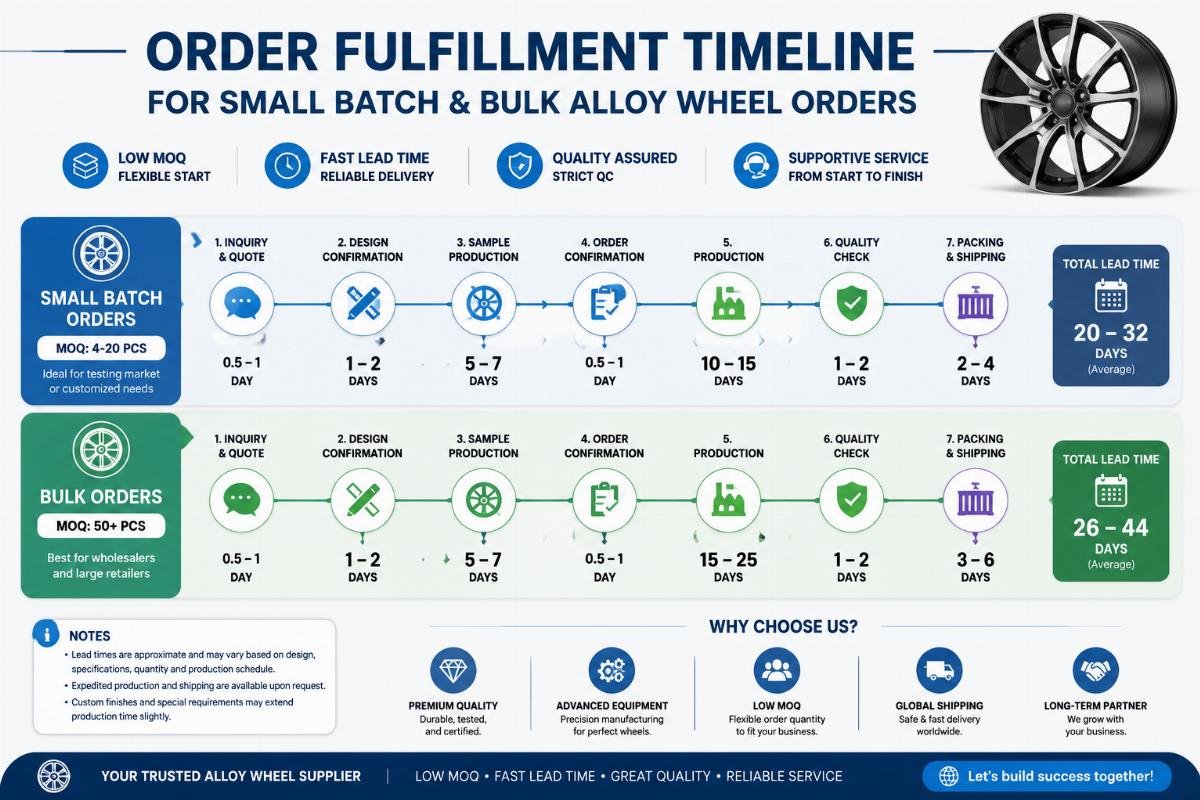
What MOQ and lead time terms fit different small and large scale sourcing needs?
| Tiered MOQ structures for stocked and custom models eliminate the need for buyers to overstock to meet arbitrary supplier minimums. Many small buyers assume they cannot access custom powder coating options due to high minimum order requirements, but specialized suppliers including Jinan Yoker Auto Parts offer 12-24 inch alloy wheels and full custom paint powder coating options aligned to flexible order sizes. | Order Type | Common Misaligned Term | Standard Optimized Term |
|---|---|---|---|
| Stocked Model Custom Finish | 200+ piece minimum order requirement | 20 piece minimum for stocked model custom finishes [NEED_CITE: Tiered MOQ rules for stocked and custom models accommodate both small tuning shop batches and large OEM bulk orders] | |
| Full Custom Design | 500+ piece minimum order requirement | 100 piece minimum for bespoke custom wheel designs | |
| Lead Time Estimate | 45+ day quoted lead time with no penalty for delays | 15-30 day production lead time with 7-21 day sea shipping for standard orders |
A Southeast Asia auto tuning shop recently placed a 35-piece batch order for custom matte black powder coated concave wheels, which was fully fulfilled in 18 days, well within the quoted lead time window. The team had previously been forced to order 200 units from another supplier, leading to 6 months of excess inventory that tied up working capital and required discounted clearance to move.
- MOQ Alignment – Confirm the supplier’s MOQ tiers match your existing order volume for core product lines before placing a first test order.
- Lead Time Buffer – Build a 7-day buffer into your project timeline to account for unexpected production delays without impacting customer delivery.
- Test Order Priority – Place a 20-50 piece test order first to verify quality, lead time and communication before committing to bulk annual contracts.
How to select coating and finish options that match local market demand?
| Matching finish trends to regional vehicle preferences directly reduces inventory turnover time and lowers excess stock risk. Global markets have distinct preference patterns: matte black and bronze finishes dominate Southeast Asian tuning segments, while gloss black and machined face finishes are the top sellers for North American mass market distributors. | Regional Market | Common Misaligned Finish Selection | High Demand Local Finish Options |
|---|---|---|---|
| North America Distributors | Oversupplying niche custom finishes | Prioritize gloss black, machined face and bronze finishes for mainstream passenger vehicles | |
| EU Modification Shops | Focusing only on standard wheel designs | Offer concave and deep lip designs in matte black for performance vehicle segments | |
| Global OEM Segments | Offering only basic coating options | Standardize on durable powder coating finishes that meet long-term road wear requirements [NEED_CITE: Popular finish types including gloss matte black bronze and custom powder coating align with mainstream vehicle models for global regions] |
Working with a US-based tire retailer last quarter, we helped them adjust their
