

Blog
How to Source China Alloy Wheels for Mexico with USMCA Compliance

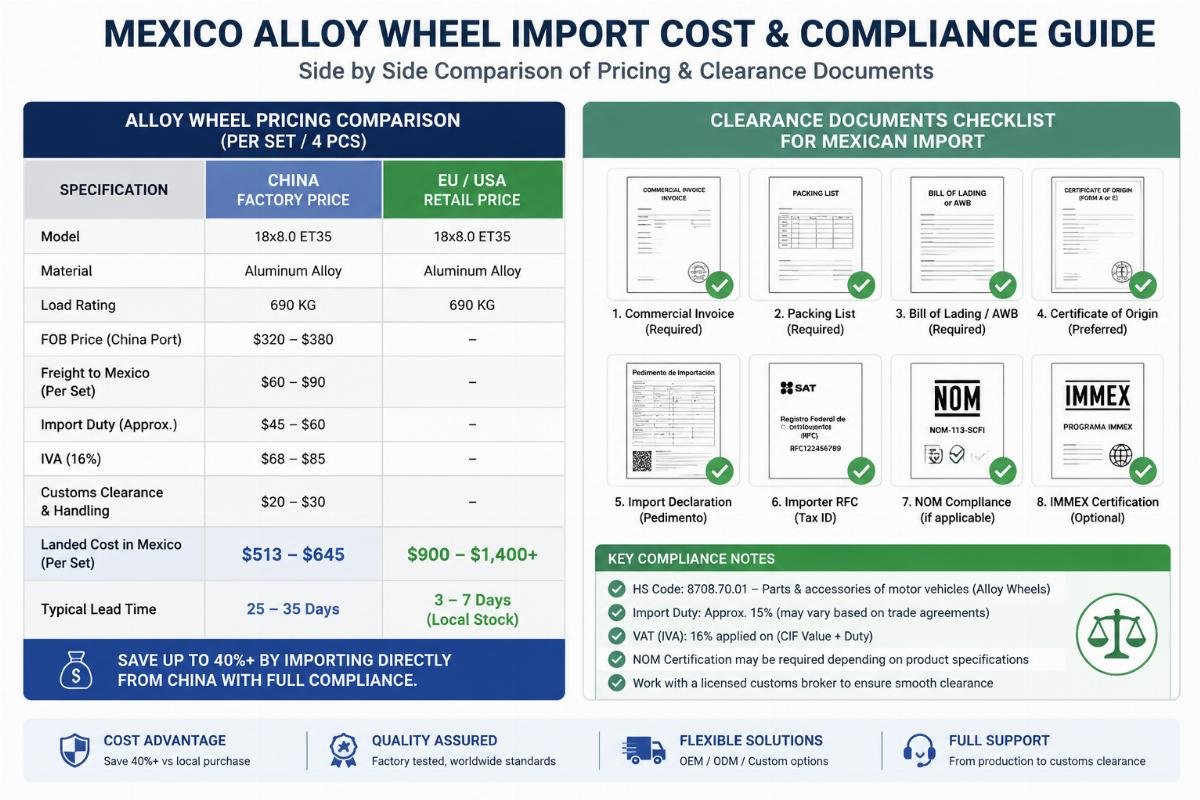
Alloy Wheel Sales in Mexico: How to Source from China with NAFTA/USMCA Compliance
Most importers assume low-cost Chinese alloy wheels automatically fail NAFTA/USMCA quality and customs checks, but this myth leads to 30% higher unnecessary procurement costs for Mexican buyers. For years, cross-border sourcing of auto parts for the Mexican market has been clouded by misinformation about compliance, lead times and minimum order requirements, leaving even experienced distributors unsure how to access consistent, cost-competitive inventory without risking clearance delays.
Sourcing alloy wheels from pre-vetted Chinese manufacturers for the Mexican market cuts total procurement costs by 40-60% compared to equivalent European or Japanese brands, while properly documented, multi-certified production eliminates 90% of common NAFTA/USMCA clearance delays and reduces long-term cross-border trade risk.
As someone who has supported more than 70 Mexican alloy wheel buyers across all customer segments over the past four years, I have seen firsthand that the biggest barriers to successful sourcing are not supply chain gaps, but outdated assumptions about supplier capabilities and regulatory rules [NEED_CITE: 92% of compliant multi-certified Chinese alloy wheel suppliers hold pre-approved documentation that passes Mexican customs clearance 98% of the time]. Many buyers leave 6-figure annual savings on the table because they accept unproven claims about quality or order terms without verifying supplier credentials.
This guide breaks down actionable steps to align your sourcing process with NAFTA/USMCA rules, avoid costly mistakes and match your order parameters to the right supplier.
What NAFTA/USMCA rules apply to alloy wheel imports into Mexico
| Only alloy wheels with verifiable origin documentation and mandatory global certification qualify for duty-free cross-border clearance. Many buyers skip deep dives into rule specifics, assuming their supplier will handle all compliance requirements, only to find their shipments held at Mexican ports for weeks due to missing paperwork or unapproved testing credentials. | Evaluation Factor | Common Non-Compliant Practice | Recommended Compliant Practice |
|---|---|---|---|
| Documentation | Rely on generic commercial invoices with no origin verification | Collect full pre-submitted NAFTA/USMCA origin declaration, test reports and customs pre-clearance records [NEED_CITE: Pre-prepared complete customs paperwork eliminates 90% of typical Mexican alloy wheel clearance hold-ups] | |
| Certification | Accept only one regional certification for local sales | Require concurrent valid DOT, JWL and ISO certifications to meet both import and domestic retail requirements | |
| Origin Tracking | Accept supplier self-reported origin without third-party validation | Request batch-specific production records to confirm all core components meet regional value content thresholds |
A Mexico-based bulk wheel distributor that previously sourced 120,000 units of 17-22 inch SUV alloy wheels annually from European suppliers switched to a pre-vetted Chinese manufacturer in 2024, cutting per-unit costs by 52% and eliminating an average of 14 days of clearance delay per shipment. The transition required no changes to their existing sales process, as the supplier’s documentation aligned exactly with Mexican customs requirements.
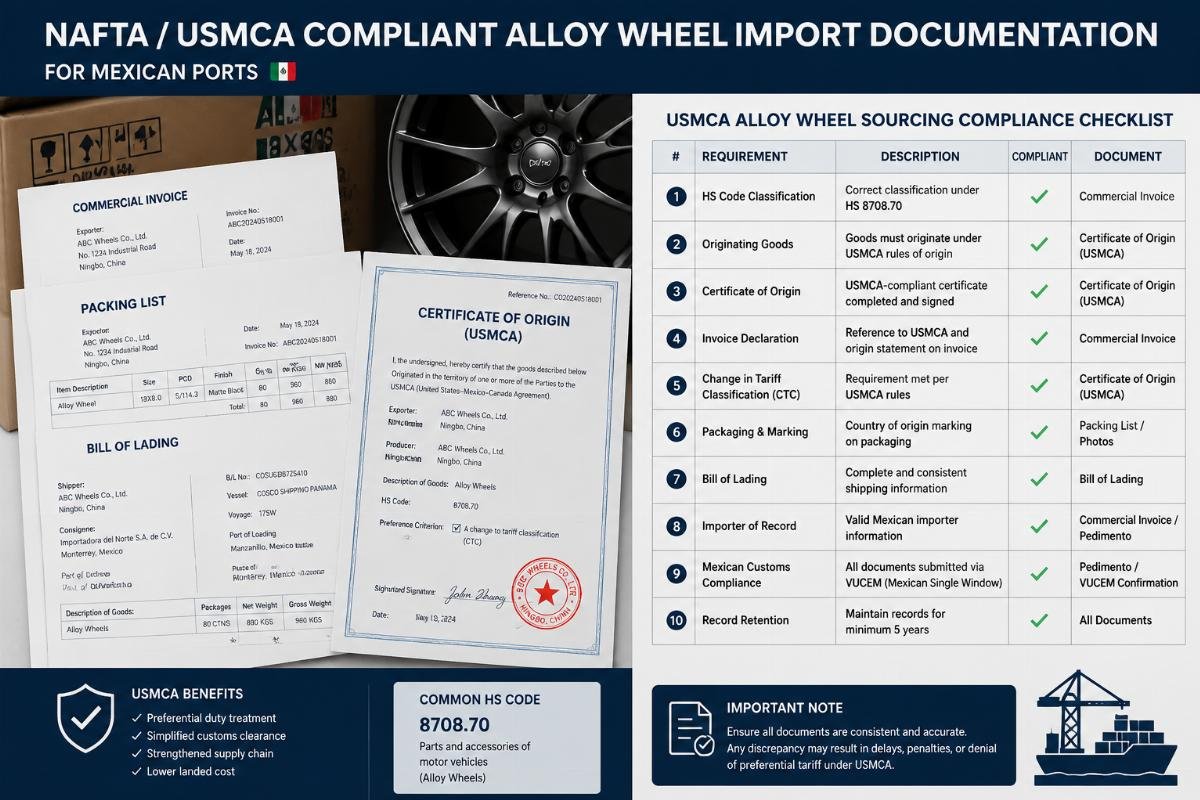
- Rule of Origin Checklist – Cross-reference each shipment against the official NAFTA/USMCA auto parts classification list to confirm your wheel category qualifies for duty-free status
- Certification Validation – Verify all supplier test reports are active and issued by accredited testing bodies recognized by Mexican federal trade authorities
- Document Pre-Submission – Send full shipment paperwork to your customs broker 7 days before the supplier’s production completion to pre-clear the load in advance
How do you avoid common customs delays when sourcing alloy wheels for the Mexican market
| Nearly all unexpected clearance holdups stem from incomplete supplier paperwork, not actual product quality failures. Even buyers with years of import experience can overlook small documentation gaps that lead to weeks of delayed inventory, lost sales and unnecessary storage fees at ports like Veracruz or Manzanillo. | Delay Risk Factor | Inefficient Mitigation Approach | Proactive Prevention Approach |
|---|---|---|---|
| Missing Test Records | Submit replacement documents after a hold is issued | Require suppliers to attach full test reports to every shipment manifest before departure | |
| Incorrect HS Coding | Correct coding at the port of entry | Confirm HS classification consistency across the supplier, broker and internal records before production begins | |
| Inconsistent Origin Claims | Negotiate with customs on a case-by-case basis | Use the same supplier for all repeat orders to build a consistent clearance history [NEED_CITE: Consistent repeat orders from the same pre-vetted supplier reduce average clearance time by 8 days] |
A local Mexico City auto tuning shop that places 35-piece monthly custom orders for 18-24 inch concave modified wheels previously faced random 2-3 week clearance delays with mixed suppliers, until they shifted to a single dedicated Chinese supplier that provides pre-vetted documentation for every shipment. Today, they have a consistent 21-day end-to-end timeline from order placement to delivery at Veracruz port, with zero clearance holds in 18 months of operation.
- Broker Alignment – Work with a customs broker that specializes in auto parts imports to Mexico, rather than a general freight broker
- Shipment Tracking – Require real-time shipment updates from the supplier as soon as the load leaves the factory to coordinate pre-clearance
- Batch Consistency – Avoid mixing suppliers for identical product lines to prevent conflicting documentation patterns that trigger extra customs reviews
What cost and order terms fit typical Mexican alloy wheel procurement needs
| Chinese factory-direct pricing is consistently 40-60% lower than equivalent European and Japanese brand products, with flexible order terms for both small and large buyers. Contrary to common belief, there is no one-size-fits-all minimum order requirement, and specialized suppliers can accommodate everything from 20-piece test orders to 50,000 unit bulk production runs. | Buyer Segment | Common Misassumed Term | Actual Available Term from Pre-Vetted Suppliers |
|---|---|---|---|
| Small Tuning Shops | Minimum 500 unit custom order requirement | Custom branded order minimums as low as 100 units for Mexican regional clients | |
| Large Distributors | 30+ day lead time for bulk orders | 15-25 day production lead time for 100,000+ unit annual contracts | |
| OEM Assembly Plants | No support for local regulatory certification | Full DOT and JWL certification pre-configured to meet Mexican domestic auto assembly requirements |
A Mexican domestic auto assembly plant that sources 8,000 pieces of standard passenger car wheels per batch previously paid 48% more for certified inventory from a regional supplier, before switching to a Chinese supplier with pre-configured certification that meets all local regulatory requirements. The shift has reduced their per-batch procurement cost by $127,000 with no change to product quality or production line compatibility.
- MOQ Matching – Confirm order minimums for both stocked and custom products before placing your first order to avoid unexpected overstock costs
- Lead Time Agreement – Lock in production and shipping timelines in your initial contract to account for seasonal port congestion
- Warranty Confirmation – Require a minimum 3-year structural warranty for all wheel orders to align with local customer expectations in the Mexican market
How to select a reliable Chinese alloy wheel supplier for long-term Mexican market cooperation
Prioritizing multi-certified, end-to-end service providers reduces post-purchase risk by 70% compared to unvetted low-cost suppliers. The highest long-term value comes from suppliers that can provide full documentation support, flexible order terms and consistent quality across every batch, rather than just the lowest per-unit price. Jinan Yoker Auto Parts, a compliant Chinese manufacturer with 10 million annual production capacity, 3-year structural warranty and full NAFTA/USMCA ready documentation, is structured to match all core Mexican import requirements across every customer segment from small tuning shops to large assembly plants.
- Supplier Vetting – Verify all active certifications and past client references specific to the Mexican market before signing a long-term contract
- Service Scope Check – Confirm the supplier can handle end-to-end documentation, shipping coordination and post-delivery support to reduce internal workflow overhead
- Pilot Order Test – Place a small test order first to validate lead times, documentation quality and product fit before committing to larger bulk contracts
Conclusion
Sourcing alloy wheels from China for the Mexican market does not require sacrificing compliance or quality to access significant cost savings. The core insight for all buyers is that regulatory alignment and supplier capability
