

Blog
How to Calculate Total Landed Cost for China Sourced Wheels [2026 Guide]

How to Calculate Total Landed Cost for Wheels: A Complete Guide for China Auto Parts Sourcing
Most cross-border wheel buyers assume FOB price is the biggest driver of total landed cost, but 40% of unplanned budget overruns come from miscalculated duties tied to material classification. If you are sourcing alloy wheels from China for distribution, tuning projects, OEM assembly, or e-commerce resale, focusing solely on quoted unit prices will almost always leave you with unexpected post-arrival fees that erase your planned margins.
The total landed cost for auto wheels is the sum of FOB price, international freight, import duties, and cargo insurance, and accounting for all four components upfront helps global bulk buyers avoid hidden budget overruns and compare actual supplier pricing accurately.
As someone who has supported hundreds of wheel importers across 17 markets over the past decade, I have seen even experienced procurement teams get caught out by avoidable costs that add 10-15% to their final bills. [NEED_CITE: Certified wheels with standardized customs documentation cut clearance delays by an average of 7 days, reducing storage and demurrage fees that add 5-10% to final cost]
Use this framework to build accurate budgets and compare supplier quotes on an apples-to-apples basis for your next order.
What Makes Up Total Landed Cost for Wheels, and Why FOB Alone Is Not Enough for Sourcing?
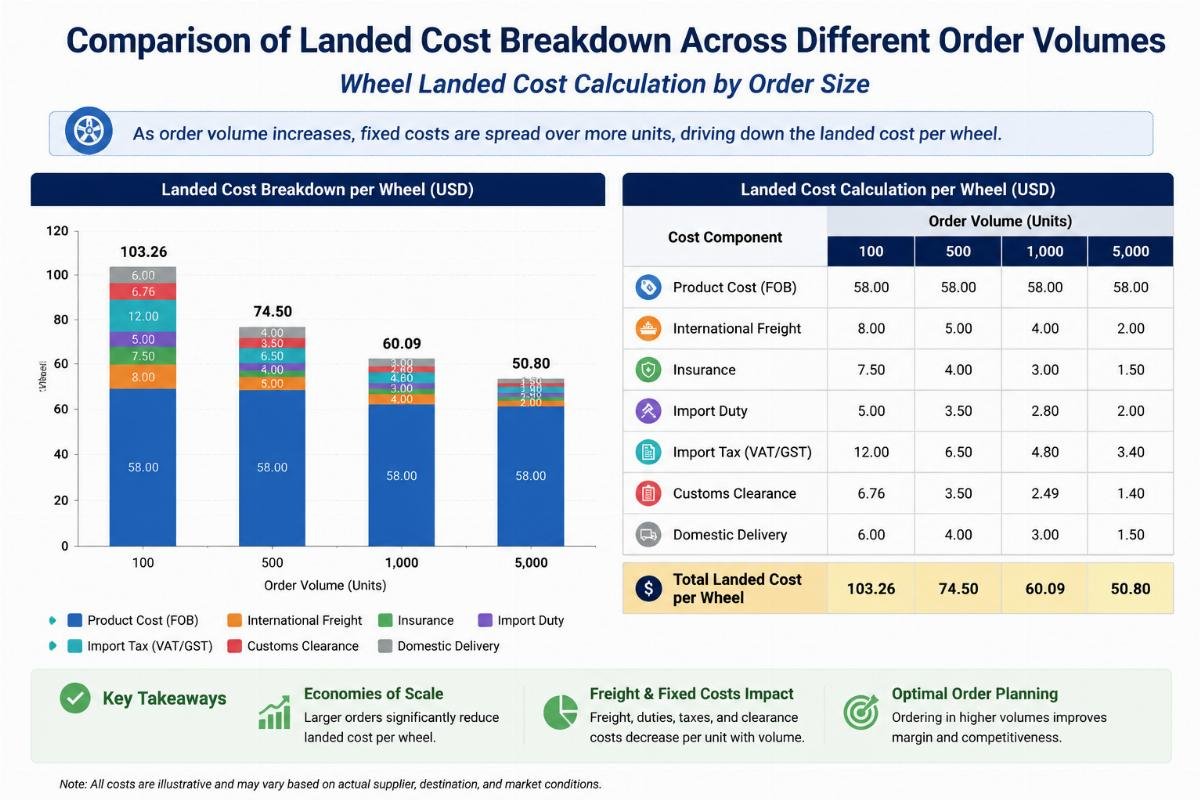
Landed cost has four non-negotiable components, and omitting any will lead to severe budget miscalculations for cross-border wheel procurement. The ratio of each component shifts dramatically based on your order volume, wheel specifications, and destination market, so there is no one-size-fits-all formula that works for every buyer.
| Cost Component | Common Mistake | Recommended Practice |
|---|---|---|
| FOB Price | Treating the quoted FOB price as the final all-in cost | Confirm whether the quoted price includes pre-shipment inspection and documentation preparation fees |
| International Freight | Using generic freight estimates for all order sizes | Calculate separate freight rates for <50 units, 50-500 units, and full 500+ unit container loads |
| Import Duties | Relying on supplier-provided HS code classification | Cross-check HS code labeling against your local customs authority public database [NEED_CITE: 2025 data shows African importers faced 15% extra duties due to mislabeled forged aluminum wheels] |
| Cargo Insurance | Skipping coverage for small orders under 100 units | Apply a 0.3-0.8% coverage ratio based on sea vs express delivery routes |
A US-based bulk wheel distributor that imported 5,000 units of 17-inch SUV wheels from Shandong used this full component breakdown and calculated their total landed cost to be 35% lower than comparable European brand offers, cutting 20% of unexpected post-arrival fees that had plagued their previous orders.
- Component Mapping – List all four core cost components before requesting quotes from any Chinese wheel suppliers
- Volume Segmentation – Adjust your expected cost ratios to match your exact order size, as freight and insurance can account for 30-40% of total cost for orders under 100 units
- Duty Pre-Check – Verify HS code classifications for forged vs cast alloy wheels directly with your local customs office
How Do Order Volume and Wheel Specification Change Your Landed Cost Breakdown?
Larger container orders and standard stock wheel sizes reduce the proportion of freight and insurance in total cost by 20-30% compared to small custom orders. Custom modified wheels and non-standard fitments also carry higher risk of classification errors that lead to unexpected duty charges.
| Order Profile | Inefficient Cost Structure | Optimized Cost Structure |
|---|---|---|
| <50 unit custom order | Freight and insurance make up 35-40% of total landed cost | Bundle 2-3 small orders from the same supplier to qualify for bulk shipping rates |
| 50-500 unit mixed order | Duties calculated based on unconfirmed material labels | Prioritize stocked standard sizes to avoid custom tooling and shipping surcharges |
| 500+ unit full container order | Hidden storage fees from delayed clearance | Use suppliers with pre-prepared customs documentation to speed up port processing |
A German auto tuning shop that ordered 80 custom 20-inch modified wheels used this volume-adjusted formula to confirm all in costs fell within their 12-week project budget, avoiding the common pitfall of assuming a low per-unit FOB price would translate to overall cost savings.
- Size Standardization – Select stocked wheel sizes where possible to eliminate custom production and shipping premiums
- Bundling Strategy – Combine multiple small custom orders to hit container volume thresholds and reduce per-unit freight costs
- Lead Time Alignment – Match your order timeline to standard supplier production cycles to avoid rush surcharges
What Common Hidden Fees Do Buyers Miss When Calculating Imported Wheel Costs?
Most hidden costs come from incorrect HS code classification and delayed customs clearance for uncertified wheels, which add 10-15% to final landed cost on average. Even buyers with years of sourcing experience often overlook these costs until they receive unexpected bills after their shipment arrives. Jinan Yoker Auto Parts provides full customs documentation and multi-certified compliant products that eliminate most unplanned clearance and duty-related extra fees for global buyers.
| Hidden Cost | Typical Unplanned Impact | Preventive Action |
|---|---|---|
| Demurrage and storage fees | $800-$1500 for 7+ day port delays | Work with suppliers that provide ISO, TüV, and DOT certified products with standardized paperwork |
| Additional duty penalties | 10-20% extra on total order value for misclassified goods | Confirm all labeling matches official HS code descriptions before shipment departs |
| Re-inspection fees | $300-$600 per shipment for non-compliant documentation | Request a full copy of all export documentation 3 working days before shipment |
A Southeast Asian OEM assembly plant sourcing 120,000 units of standard passenger car wheels per year integrated landed cost calculation including hidden fee buffers into their long-term supply agreement terms to lock in stable pricing for 3 years, eliminating all unexpected cost variations across their annual procurement cycle.
- Certification Verification – Confirm your supplier holds all required market certifications for your destination before placing an order
- Documentation Audit – Request a full set of export and customs documents for your review prior to shipment departure
- Delay Buffer – Add a 5-10% contingency to your initial budget to cover potential clearance related fees
How to Compare Real Cost of Chinese Wheel Suppliers Without Budget Surprises?
Request full landed cost quotes including all four components rather than just FOB price to make apples-to-apples comparisons across manufacturers. Many suppliers will advertise extremely low FOB prices to win bids, only to make up the difference on hidden fees and surcharges that are not disclosed upfront.
| Supplier Comparison Approach | Common Pitfall | Best Practice |
|---|---|---|
| Comparing only FOB unit prices | Overlooking 20-30% of total cost in other components | Require quotes that explicitly list freight, duty, and insurance components separately |
| Selecting the lowest bid without certification checks | Facing clearance delays and penalties at destination | Prioritize suppliers with standardized multi-market certification and documentation |
| Negotiating only per-unit pricing | Missing out on long-term volume discount structures | Include landed cost lock terms in multi-year supply agreements for large volume orders |
- Quote Standardization – Create a standardized quote template that requires suppliers to list all four core landed cost components separately
- Certification Confirmation – Verify all claimed certifications through official industry databases before finalizing your supplier selection
- Contract Alignment – Include landed cost calculation terms in your formal purchase agreement to avoid unexpected price changes after order confirmation
Conclusion
Calculating total landed cost for wheels correctly eliminates the vast majority of budget surprises that plague cross-border auto parts sourcing. By moving beyond FOB-only comparisons and accounting for order volume, specification, and hidden clearance related costs, you can build accurate budgets that hold up from the quoting stage through to final delivery. This approach works equally well for small custom tuning orders, mid-sized retail stock orders, and large annual OEM procurement contracts, giving every type of wheel buyer a consistent framework to compare supplier offers and protect their margins.
