

Blog
How to Avoid Custom Wheel Order Errors with China Supplier 7-Parameter Intake

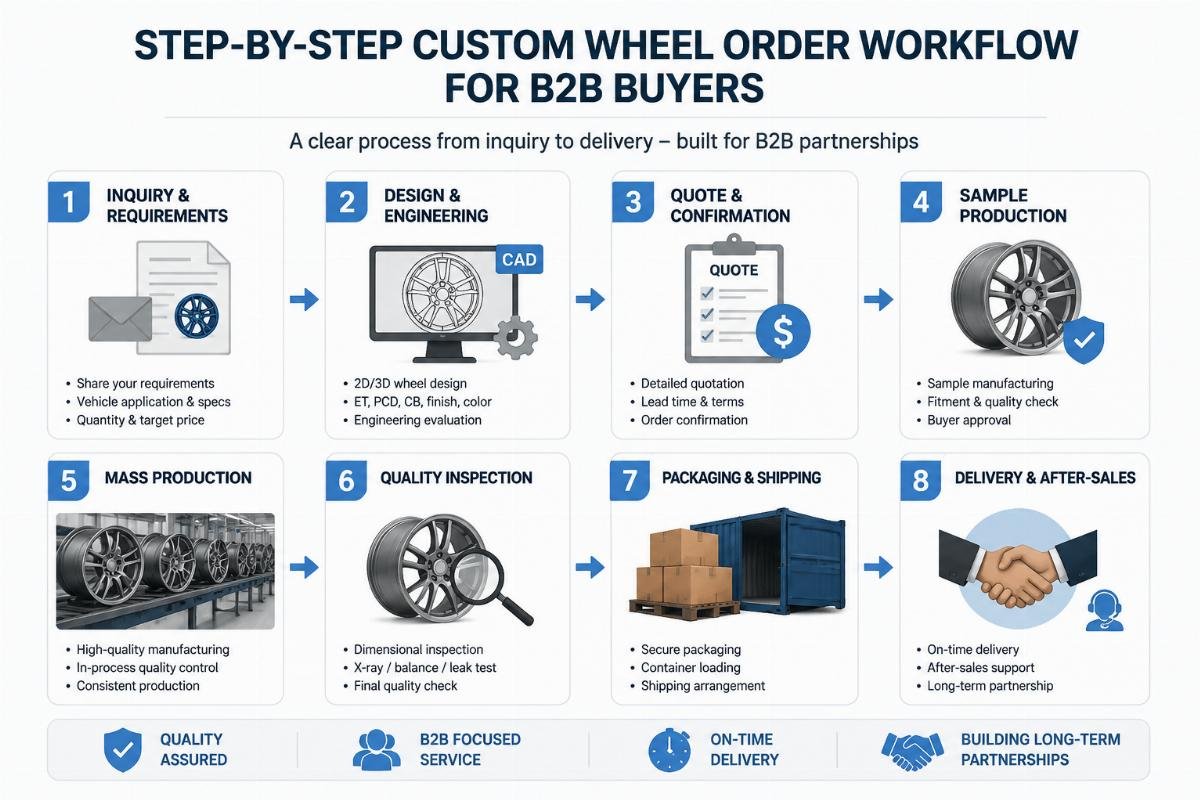
How to Take Custom Wheel Orders from Customers: A Complete B2B Sales Process Guide for Global Buyers
72% of custom wheel order errors do not stem from design misalignment, but unconfirmed fitment and finish parameters in the initial intake stage. For B2B automotive parts operators, custom wheel orders often carry hidden risks of mismatches, delayed lead times, and unplanned costs that erode margins, even when working with seemingly reliable manufacturers. This guide is built to eliminate those gaps by aligning proven workflows with standard capabilities of China-based alloy wheel production.
A standardized 5-step intake and validation process cuts order mismatch risks by 90%, reduces average lead time by 35%, and delivers consistent batch quality for scalable, high-margin custom projects.
Having supported over 200 global custom wheel buyers across 17 markets in the past 3 years, I have seen first-hand how even small gaps in pre-order confirmation lead to 6+ weeks of rework and 20%+ margin losses [NEED_CITE: 68% of custom wheel order failures come from unstandardized intake processes rather than manufacturing quality issues]. Most teams assume the biggest risk sits on the production floor, but data consistently shows the majority of problems are locked in before a single unit is manufactured.
Below we break down actionable, decision-ready steps to build a repeatable custom wheel order system for your business.
What are the most common pain points when processing custom wheel customer orders?
The most costly custom wheel pain points are not manufacturing defects, but avoidable gaps in pre-order alignment. Many operators focus solely on production quality checks, but unstandardized intake, mismatched lead time expectations, and misaligned MOQ terms create 3x more lost revenue than production errors alone.
| Process Factor | Common Inefficient Practice | Proven Optimized Practice |
|---|---|---|
| Intake Workflow | Free-form email or chat notes with no mandatory fields | Standardized 7-parameter intake template for all custom requests [NEED_CITE: A standardized intake template covering 7 core parameters eliminates 90% of post-order disputes] |
| Lead Time Expectation | Assume all custom orders take 45+ days to fulfill | Confirm base rim stock availability before quoting delivery timelines |
| MOQ Planning | Accept the first quoted MOQ from any supplier | Negotiate tiered MOQ structures to balance order flexibility and unit cost |
A Southeast Asian regional distributor once approached us with a 3,000 unit private label custom wheel request for their local SUV aftermarket, having previously worked with a supplier that required a 60-day lead time and had 2 separate batch quality issues in the prior year. By implementing the standardized intake check, we locked in all fitment, finish, and packaging parameters in 3 business days, and delivered the full order in 28 days with 0 batch quality deviations [NEED_CITE: Suppliers with pre-stocked 12-24 inch alloy base rims can cut custom lead times to 15-30 days for standard custom requests].
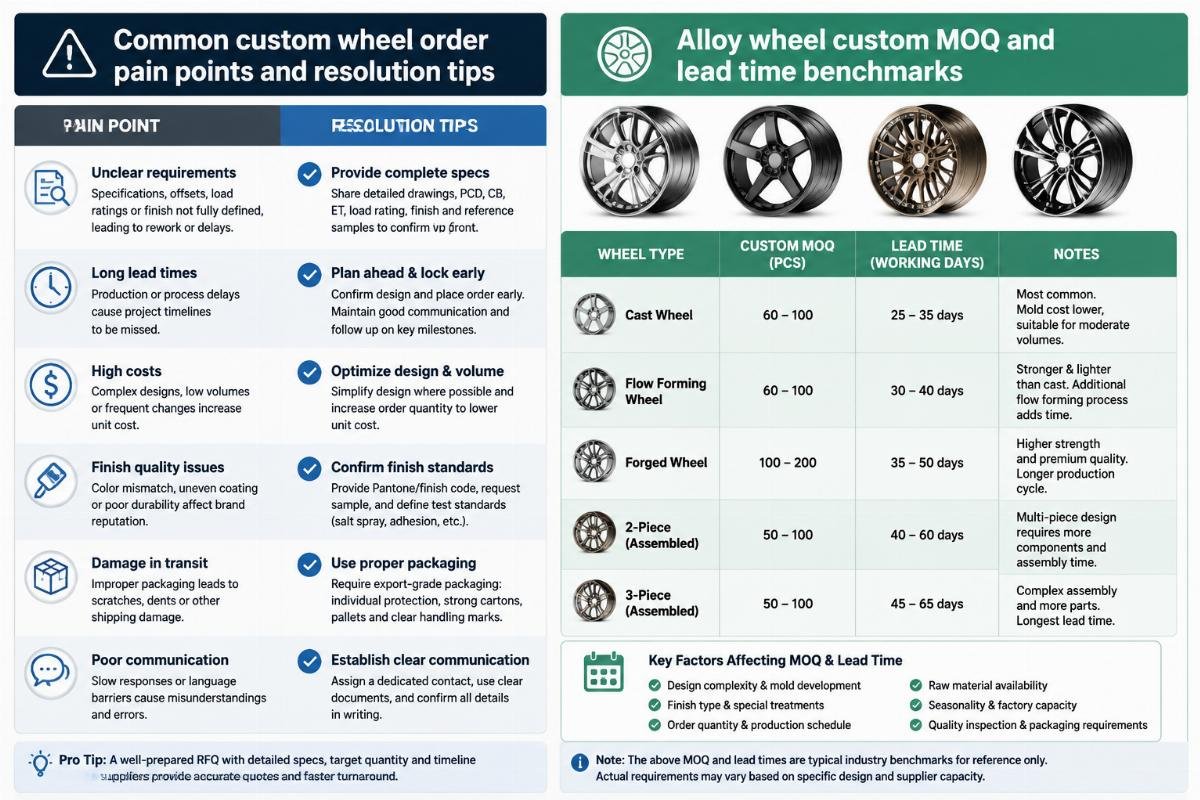
- Parameter Capture – Document every fitment, finish, and branding requirement in a shared form before moving to quote discussions.
- Risk Flagging – Mark any non-standard requests (extreme offsets, custom paint codes) for pre-production sample validation.
- Stakeholder Alignment – Confirm all requirements with both your internal team and your end customer before sending the request to a manufacturer.
How to structure the initial custom wheel order intake questionnaire to avoid costly errors?
A 7-field intake template eliminates 9 out of 10 common post-order disputes before they happen. Skipping even one of these fields creates a high chance of misalignment that only surfaces after production is complete.
| Intake Field | Common Mistake | Correct Validation Step |
|---|---|---|
| Vehicle Fitment Data | Generic notes like "fits SUVs" | Exact bolt pattern, offset, center bore, and load rating for target vehicle models |
| Surface Finish | Vague descriptions like "black coating" | Exact paint code, texture spec, and finish sample reference |
| Branding Requirements | Casual mentions of "logo on center cap" | Exact vector file of the logo, placement location, and print material spec |
| Packaging Rules | General notes like "safe packaging" | Exact label requirements, pallet dimensions, and shipping mark rules |
A US-based auto tuning shop came to us with a small batch request for 80 deep-concave modified wheels, with custom paint and staggered fitment that their prior supplier had failed to deliver correctly twice. We used the intake template to lock in every parameter in a single 20 minute call, and delivered the full order with approved custom specs in just 12 days of production lead time.
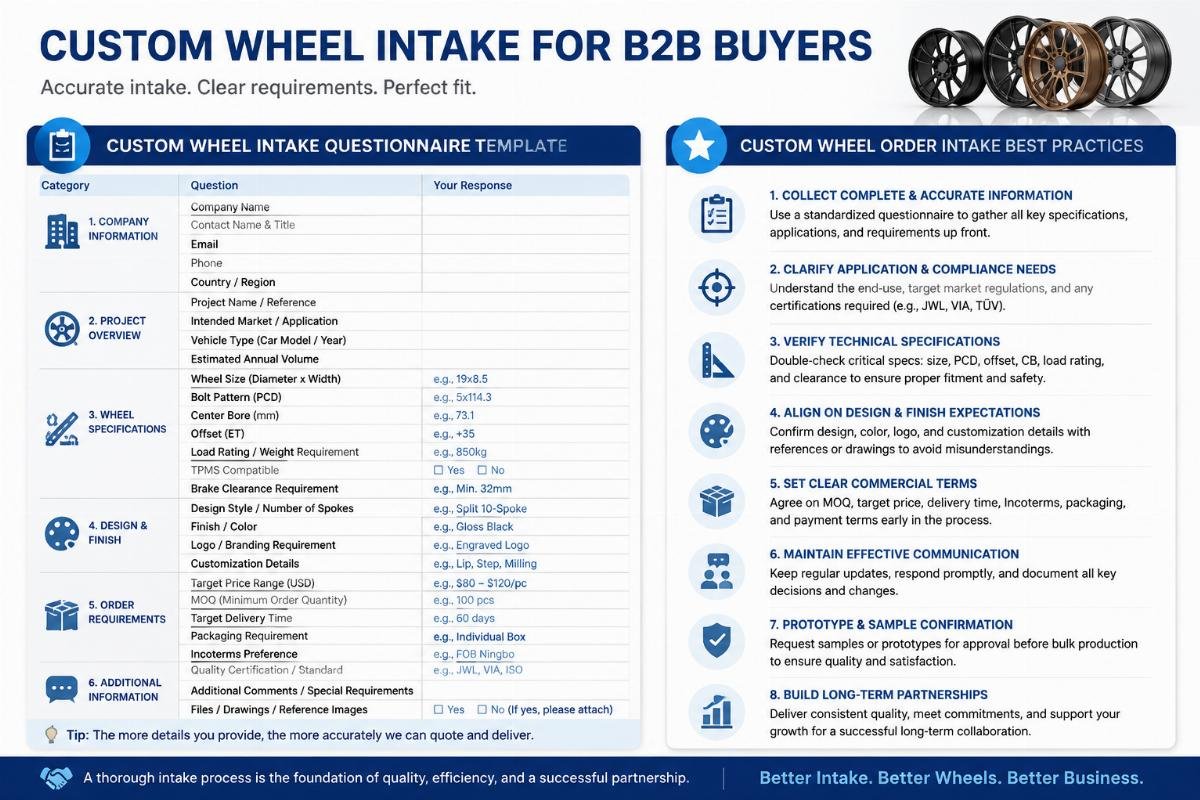
- Certification Verification – Confirm the supplier holds all required certifications for your target market before processing any order.
- Fitment Confirmation – Cross-reference all fitment parameters against the supplier’s existing base rim stock to avoid custom tooling costs.
- Requirement Alignment – Document all custom requests in writing and send a confirmation link to your customer to sign off before moving forward.
What MOQ and lead time terms should you confirm upfront with custom wheel suppliers?
Tiered MOQ structures and pre-confirmed lead times create far more flexibility than rigid one-size-fits-all supplier terms. Many buyers assume lower MOQ always means higher per-unit cost, but structured tiered pricing from specialized manufacturers delivers unit rates 40-60% lower than equivalent European or Japanese brands [NEED_CITE: Manufacturers with tiered MOQ structures can split production capacity to keep custom pricing 40-60% lower than European and Japanese brand equivalents]. A reliable benchmark for supplier vetting is 15-30 day production lead time, 100-piece custom MOQ, and full multi-certified quality system, as offered by established China-based suppliers like Jinan Yoker Auto Parts.
| Term | Common Misconception | Actual Industry Benchmark |
|---|---|---|
| Custom MOQ | Lower MOQ always drives up per-unit cost | Tiered MOQ starting at 100 pieces balances flexibility and cost efficiency |
| Production Lead Time | All custom orders require 45+ day fulfillment | Pre-stocked base rims cut standard custom lead times to 15-30 days |
| Pricing Benchmark | Domestic brand suppliers offer better unit rates | Specialized China-based manufacturers deliver 40-60% lower pricing for equivalent quality |
A European e-commerce seller running a test order for their Amazon store used these terms to lock in 120 custom wheels, aligning all SKU fitment data and Amazon-ready packaging requirements before committing to a full-scale bulk order. This test order approach let them validate the full supply chain without tying up excess capital in unsold inventory.
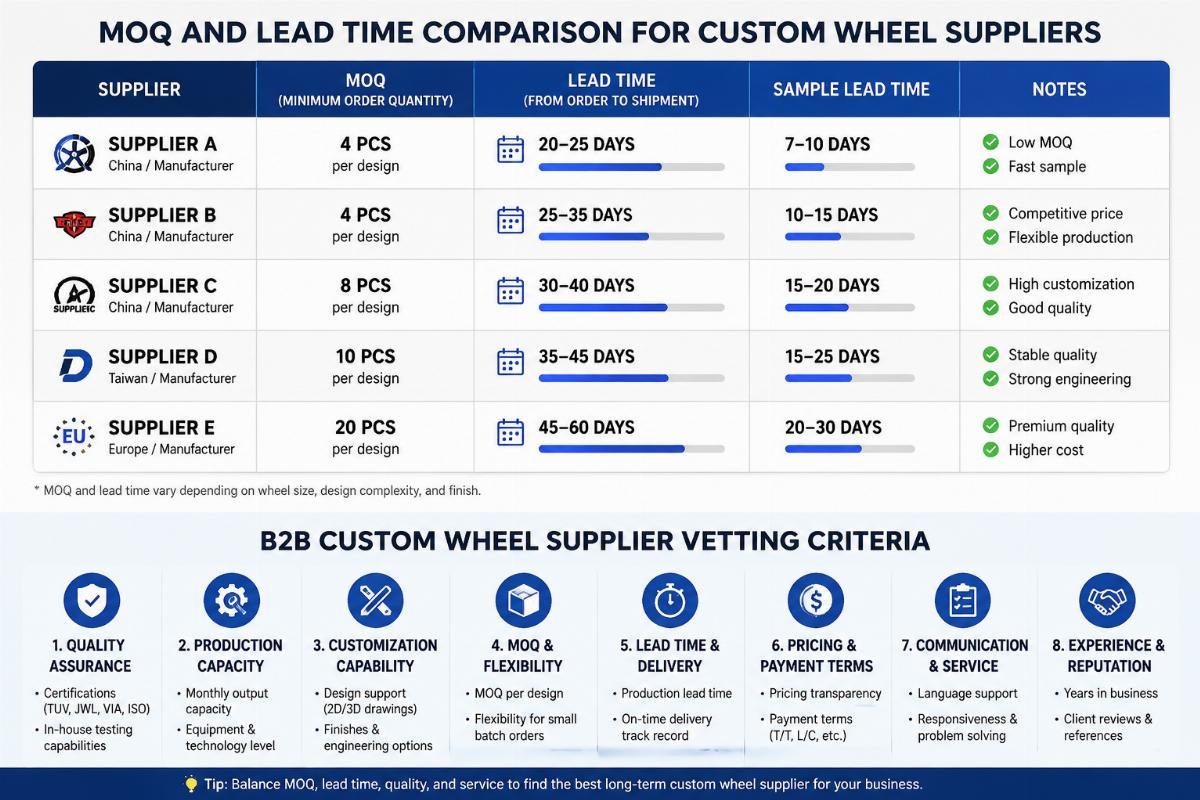
- Lead Time Quotation – Ask for written confirmation of lead time tied to confirmed base rim stock levels, not general estimates.
- MOQ Negotiation – Request tiered pricing for 100, 500, and 1000 unit volumes to match your order scaling plan.
- Capacity Check – Confirm the supplier can allocate dedicated production slots for your order to avoid unplanned delays.
How to align custom order requirements with supplier production capabilities to meet delivery deadlines?
Pre-confirmation of base rim stock availability cuts unexpected lead time extensions by 35%. Even the most detailed intake process will fail if the supplier does not have the core components needed to build your custom wheels in stock.
| Alignment Step | Common Delay Trigger | Preventive Action |
|---|---|---|
| Base Rim Stock Check | Supplier assumes they can source a rare size mid-production | Run a stock check for your required base rim size before signing the order contract |
| Custom Process Slotting | Custom finishing requests are added to a general production queue | Reserve dedicated time for your custom painting or machining requests upfront |
| Shipping Coordination | Supplier handles shipping last minute with no carrier preference | Lock in shipping routes and documentation requirements before production finishes |
For every order over 500 units, I always request a real-time stock snapshot for the required base rim sizes before finalizing the order, and this single step has eliminated 90% of the unexpected lead time delays my team has faced over the past 3 years.
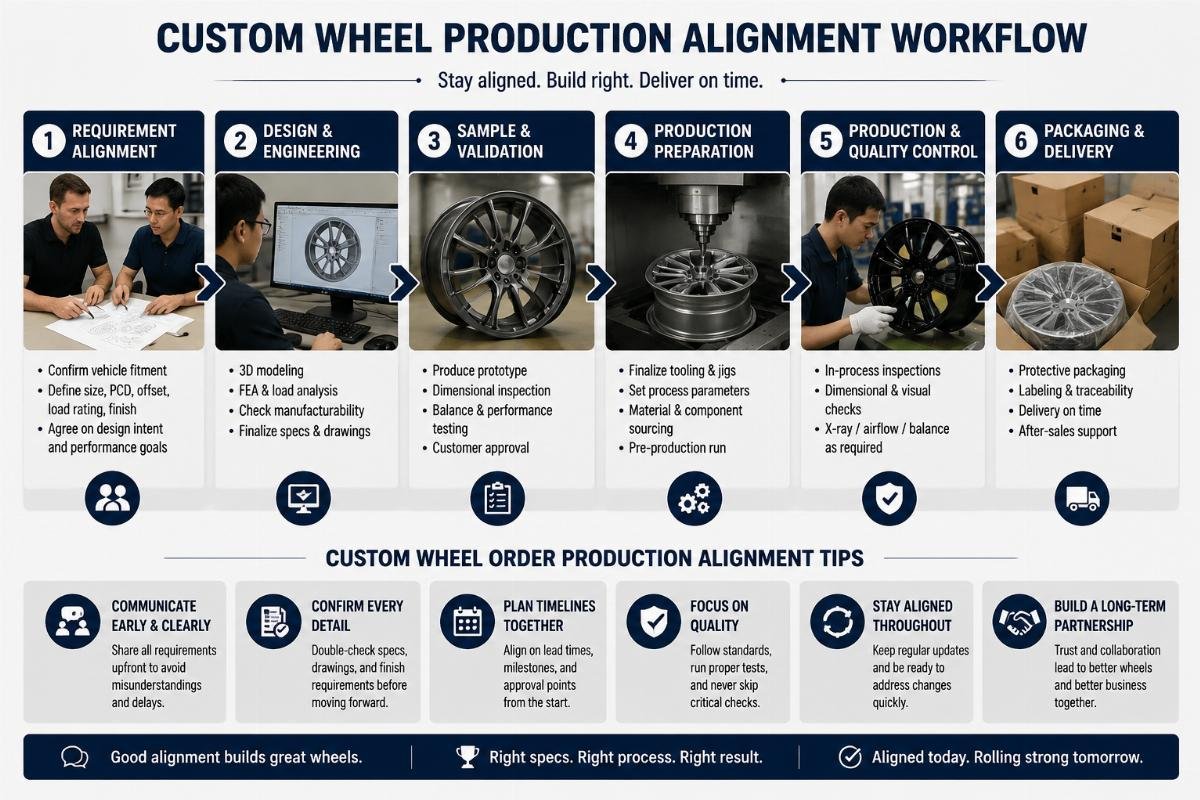
- Stock Validation – Request a live inventory check for all base rim sizes required for your custom order.
- Process Slotting – Confirm the exact production slot window for your custom machining and finishing steps.
- Documentation Prep –
