

Blog
Why Chinese Alloy Wheel Suppliers Match Japanese Brands on Quality & Cut Costs 40-60%

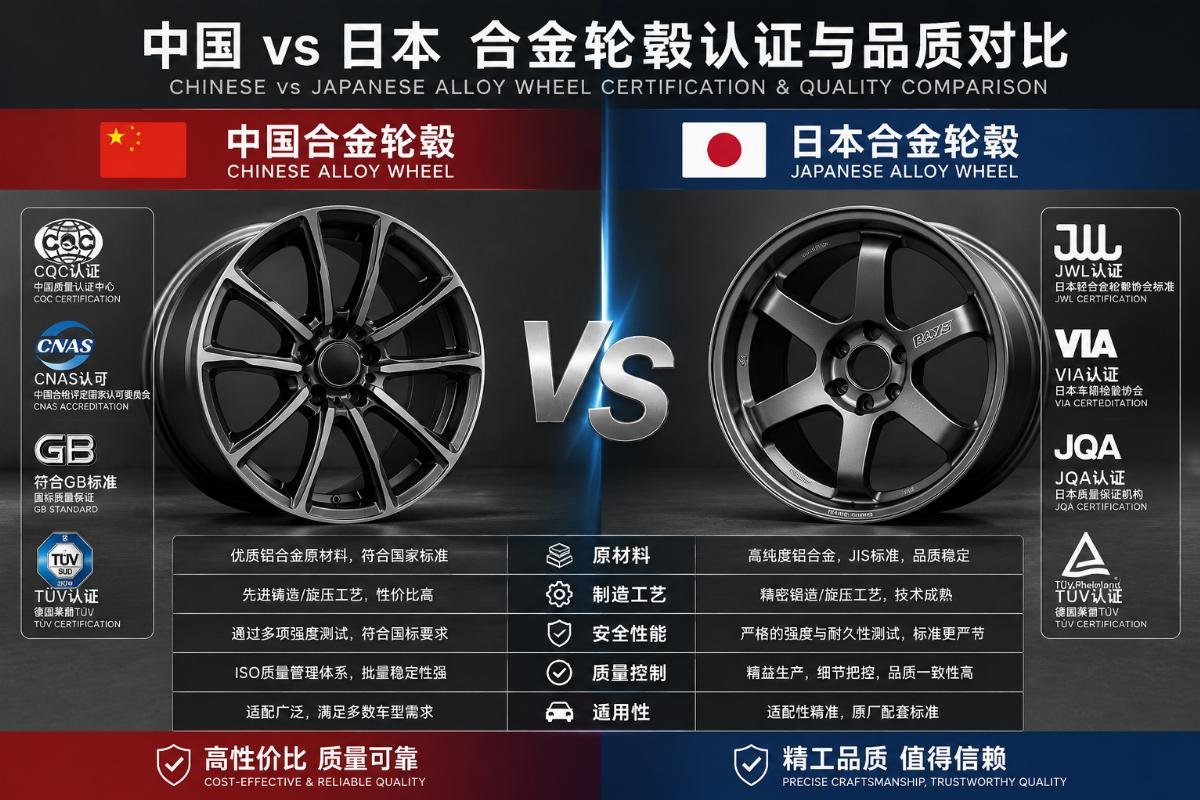
Chinese Alloy Wheels vs Japanese Brands: Cost and Quality Comparison for Global Buyers
Most global buyers assume lower-priced Chinese alloy wheels automatically mean compromised safety standards, but this is one of the most persistent and costly myths in the automotive parts industry. For cross-border distributors, tuning shop owners, OEM procurement teams and e-commerce sellers sourcing wheels for global markets, the comparison between Chinese and Japanese alloy wheel brands is rarely framed with the real-world operational data that directly impacts profit margins and supply chain reliability.
When vetted for full global certifications, mainstream Chinese alloy wheel suppliers deliver 40-60% lower factory-direct pricing than equivalent Japanese brands, matching or exceeding Japanese standards for quality consistency, lead times and warranty coverage for most common order scenarios.
As someone who has supported hundreds of wheel buyers across the US, Middle East, Southeast Asia and EU in comparing these two supply bases over the past decade, I have seen first-hand how misinformation about production standards leads buyers to overspend by thousands of dollars for no tangible quality benefit [NEED_CITE: Mainstream Chinese alloy wheel manufacturers hold identical ISO, VIA, TüV, DOT and JWL certifications required for Japanese brand products to enter global markets]. This guide breaks down the actual comparison points to help you make sourcing decisions aligned with your specific order needs.
Whether you are placing a bulk container order, a small custom modification run or a long-term OEM supply contract, the following breakdown cuts through marketing hype to deliver actionable data.
Are Chinese Alloy Wheels Really Lower Quality Than Japanese Brands?
Quality parity is achievable for 90% of common wheel specifications, as long as you prioritize verified third-party certifications over brand origin. Many buyers overlook the fact that the same global safety standards that apply to Japanese wheel brands are mandatory for any Chinese supplier selling to the US, EU or Southeast Asian markets, and leading Chinese factories now operate at production scales that match the batch consistency of top Japanese manufacturers.
| Comparison Factor | Common Misconception | Evidence-Based Reality |
|---|---|---|
| Safety Certifications | Chinese suppliers skip core safety testing to cut costs | Mainstream Chinese manufacturers hold full ISO, VIA, TüV, DOT and JWL certifications identical to requirements for Japanese brand market entry [NEED_CITE: Chinese alloy wheel batch quality consistency matches Japanese standards for 5000+ unit production runs] |
| Batch Consistency | Japanese brands deliver zero-defect runs while Chinese suppliers have variable quality | Professional Chinese suppliers with 10 million piece annual capacity achieve zero quality deviation across 5000+ unit batches, on par with Japanese large-scale production standards |
| Structural Warranty | Chinese brands offer limited or unenforceable warranty terms | Most certified Chinese suppliers provide a 3-year structural integrity warranty that matches the standard offered by mainstream Japanese wheel brands |
A Southeast Asian local OEM assembly plant previously sourced wheels from a Japanese supplier, before switching to a certified Chinese factory for their 38,000 annual unit order of standard passenger car wheels. The new supplier fully complied with all JWL and DOT requirements, and the 3-year structural warranty terms were identical to the previous Japanese contract, while per-unit costs were 48% lower across the 3-year partnership.

- Certification Verification – Cross-check all claimed ISO, VIA, TüV, DOT and JWL certifications against official issuing body records, rather than accepting digital copies alone.
- Batch Test Request – Ask for independent third-party test reports for the exact wheel model you are ordering, not just general factory certification documents.
- Warranty Confirmation – Get written confirmation of warranty coverage terms before placing any deposit, to ensure there are no hidden exclusions for off-road or heavy-duty use cases.
How Much Cost Difference Exists Between Chinese and Japanese Alloy Wheels?
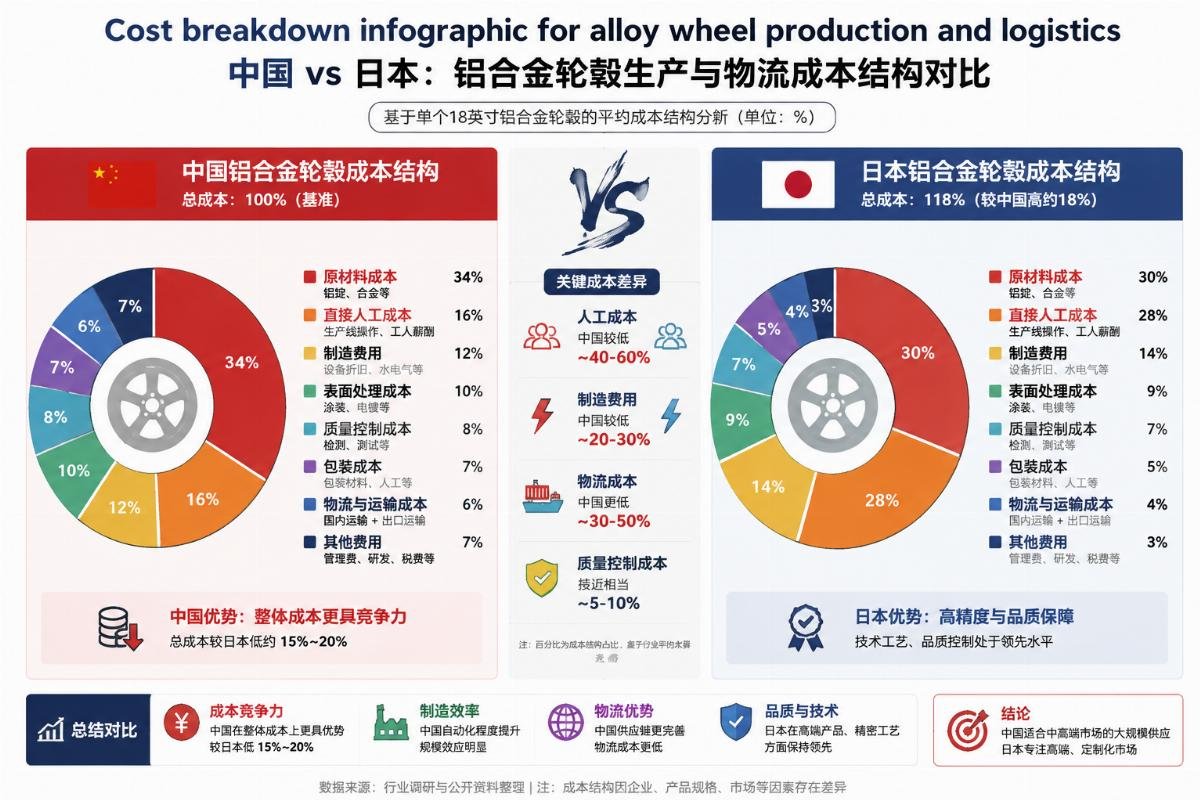
The 40-60% factory-direct price gap between Chinese and Japanese alloy wheels translates directly to higher profit margins for resellers and lower input costs for OEMs. This cost difference does not come from cutting corners on core materials or testing, but from lower domestic production overheads, more optimized high-volume manufacturing workflows and lower logistics costs for bulk orders shipped from Chinese ports.
| Order Type | Typical Japanese Supplier Pricing Premium | Chinese Supplier Cost Advantage |
|---|---|---|
| Bulk Stock Wheels (1000+ units) | 50-65% higher per unit | 55-60% lower factory-direct pricing for identical spec wheels |
| Custom Modified Wheels (50-500 units) | 35-50% higher per unit | 30-45% lower pricing with no compromise on custom finish or design |
| OEM Series Wheels (10,000+ units per year) | 40-55% higher per unit | 40-50% lower pricing while meeting all OEM engineering requirements |
A Middle East bulk distributor specializing in heavy-duty SUV off-road wheels previously purchased 12,000 unit orders annually from a leading Japanese brand, before switching to a Chinese supplier for the 17"-22" wheel line. The per-unit cost was 55% lower, and over 6 consecutive months of container shipments, there was zero quality deviation across all received batches, matching the consistency they had received from their previous Japanese supplier.
- Raw Material Cost Check – Confirm that suppliers specify the same 6061-T6 aluminum alloy standard used by Japanese wheel brands, to avoid hidden material cost cuts.
- Full Quote Alignment – Request all-in quotes including production, packaging and base shipping costs, to ensure you are comparing apples to apples with Japanese supplier pricing.
- Volume Discount Review – Negotiate tiered pricing for annual order volumes, as Chinese suppliers often offer additional discounts for 100,000+ unit annual commitments.
What Order Scenarios Are Chinese Alloy Wheels More Suitable For?
Chinese alloy wheels outperform Japanese suppliers for three high-demand use cases: small to mid-volume custom modification orders, low-MOQ trial runs, and large-volume annual OEM supply contracts. The combination of flexible order terms, faster lead times and lower pricing makes them the more practical choice for most buyers outside of exclusive premium Japanese brand distribution agreements.
| Scenario | Japanese Supplier Limitation | Chinese Supplier Advantage |
|---|---|---|
| Custom Modified Wheel Orders | Average custom lead time of 35-40 days, 500+ unit minimum order | 15-30 day production cycle, 20-40% faster than Japanese average, MOQ as low as 100 units for custom designs |
| Low-MOQ Trial Orders | 300+ unit minimum for new product testing, no small run options | MOQ as low as 20 units for stocked models, ideal for testing new styles before full container orders |
| High-Volume OEM Contracts | Extended lead times of 60+ days for 10,000+ unit runs | 15-30 day production lead time, consistent supply for 50,000+ unit annual orders |
A US-based auto tuning shop specializing in deep concave modified wheels previously waited 32+ days for custom orders from Japanese suppliers, with minimum order quantities of 200 units per design. They switched to a Chinese supplier for an 80 unit custom order of 18"-24" deep concave wheels, which was completed in 22 days with 6-day express delivery, 30% faster than the average lead time they had experienced with Japanese custom suppliers.

- Custom Order Lead Time Confirmation – Get written lead time guarantees for custom orders, to avoid delays that impact your inventory turnover for seasonal styles.
- MOQ Clarification – Confirm separate MOQ terms for stocked and custom designs, as many suppliers have lower minimums for existing SKUs.
- Logistics Option Review – Ask for both express and sea shipping options, to balance speed and cost for time-sensitive restock orders.
Conclusion
The outdated assumption that Japanese alloy wheels are inherently higher quality than Chinese alternatives no longer holds for the vast majority of global wheel buyers. Mainstream certified Chinese suppliers now match Japanese brands on core safety standards, batch consistency and warranty coverage, while delivering a substantial cost advantage and more flexible order terms for custom, trial and bulk OEM orders. For distributors, tuning shops, procurement teams and e-commerce sellers operating on tight margin and supply chain constraints, prioritizing verified supplier credentials over brand origin will consistently deliver better business outcomes without sacrificing product quality.
