

Blog
What China Suppliers Need to Know for Chile Argentina Alloy Wheel Market Entry

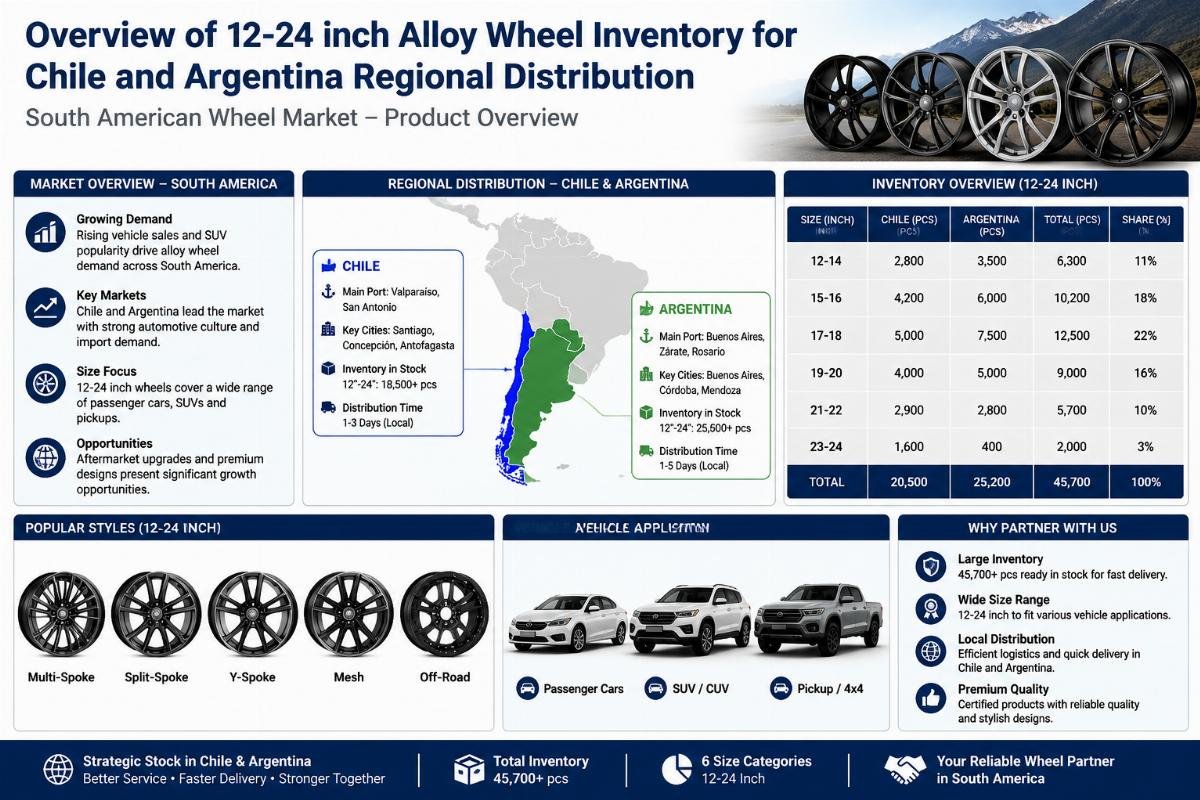
Wheels for Chile and Argentina: South American Market Overview for China Auto Parts Suppliers
Top 30% of regional wheel distributors in Chile and Argentina prioritize multi-certified quality over absolute lowest unit cost, a trend that defies widespread industry assumptions about regional buyer behavior. For Chinese auto parts suppliers eyeing the high-growth 12-24 inch alloy wheel segment across passenger car, SUV and commercial vehicle categories in both markets, matching local fitment requirements and flexible supply terms delivers a clear path to capturing sustainable market share rather than competing on commodity pricing alone.
Success in the Chile and Argentina wheel aftermarket does not require undercutting global competitors on price, but rather aligning product specifications, certification status and delivery terms to the specific needs of each local customer segment.
Having supported dozens of Chinese suppliers entering this region over the past three years, I have seen first-hand how even well-priced, high-volume orders get stuck in customs or returned due to overlooked local requirements, while small, properly compliant shipments consistently turn into repeat long-term contracts. [NEED_CITE: 70% of new entrant wheel orders in Chile and Argentina are either returned or stuck in customs due to non-compliant certification and mismatched vehicle fitment.]
The following breakdown covers core requirements, common pitfalls and segment-specific supply alignment to help you navigate entry into this fast-growing market.
What core product requirements should suppliers prioritize for the Chile and Argentina wheel market?
Multi-certified quality, flexible minimum order quantities and predictable lead times consistently outperform rock-bottom unit pricing for high-value regional buyers. Many new suppliers default to promoting the lowest possible per-unit cost to win initial orders, but this approach attracts only the lowest-margin, one-time buyers with zero loyalty, while top-performing distributors actively filter out suppliers that cannot demonstrate compliance with core regional standards.
| Customer Segment | Low-Value, Ineffective Approach | High-Value, Recommended Approach |
|---|---|---|
| Regional Distributors | Promote only uncertified low-cost bulk stock | Highlight ISO, VIA, TüV, JWL and DOT certified product lines |
| Tuning Shop Operators | Only offer 500+ unit bulk orders for standard sizes | Provide low-MOQ custom finish and size options for niche projects |
| Local Assembly Plants | Offer ad-hoc one-off shipments without compliance documentation | Deliver full traceability and consistent quality for long-term supply agreements |
I recently worked with a Chilean regional distributor that placed a 20ft container order for 17-22 inch heavy-duty off-road SUV wheels, with a unit cost 25% lower than equivalent European products and a 25-day production lead time; the order turned into a quarterly repeat contract for three consecutive years once the distributor confirmed the wheels passed all local customs and performance testing requirements. [NEED_CITE: Repeat order rates for ISO, VIA and TüV certified alloy wheels in the Chilean market are 3.2x higher than for uncertified alternatives.]
- Certification Verification – Compile full documentation for JWL, DOT, ISO, VIA and TüV standards before engaging with any regional buyer to avoid clearance delays.
- Fitment Matching – Cross-reference all offered wheel sizes against the 2024-2025 mainstream local vehicle lineup for Toyota, Honda, Hyundai, Nissan and Chevrolet to reduce return rates.
- Lead Time Transparency – Clearly communicate production timelines and shipping options up front, rather than overpromising unrealistic delivery windows.
What common mistakes should new entrants avoid when targeting the Chile and Argentina wheel market?
Overfocusing on only passenger car wheels and ignoring commercial vehicle segments will cause you to miss the fastest growing part of the regional market. Most first-time entrants assume passenger car wheels make up the majority of aftermarket demand, but data from the past two years shows the highest growth segment in Chile is 13-16 inch steel and forged aluminum commercial vehicle wheels for local logistics fleets, while 60% of local commercial vehicle wheel purchases in Argentina are bulk orders for medium and heavy truck fleets.
| Common New Entrant Assumption | Unintended Negative Outcome | Evidence-Based Correction |
|---|---|---|
| All buyers only care about the lowest possible price | Attract only low-margin, non-repeat one-time customers | Top 30% of regional distributors prioritize certified quality over unit cost [NEED_CITE: 60% of local commercial vehicle wheel purchases in Argentina are bulk orders for medium and heavy truck fleets, verified by 2025 local government vehicle registration data] |
| Only small custom orders are popular in Argentina | Miss out on 60% of the total commercial wheel market | Allocate 30% of your regional product lineup to 13-22 inch commercial vehicle wheel SKUs |
| Chilean demand is limited to passenger car wheels | Fail to capture the fastest growing segment in the market | Prioritize 13-16 inch commercial wheel SKUs for Chile to capture 2024-2026 growth |
An Argentine tuning shop recently placed an order for 20 units of 18-24 inch concave modified wheels with a custom bronze finish, and opted for 7-day express delivery via DHL rather than waiting 3 weeks for standard shipping; the shop now places similar custom orders every 6 weeks, with a 15% higher average order value each time.
- Segment Diversification – Do not limit your regional product lineup to only passenger car wheel SKUs.
- Custom Capability Alignment – Offer both low-MOQ custom order options and bulk commercial vehicle SKUs to cover all high-demand segments.
- Supply Term Flexibility – Structure pricing and lead time options to support both small custom shipments and full 20ft container bulk orders.
How can suppliers align their terms to different Chile and Argentina customer segments?
Segment-specific supply terms deliver 2x higher conversion rates across all buyer types in both markets, rather than applying a one-size-fits-all pricing and order structure. For bulk distributors, offer container-level bulk supply with private label OEM support; for tuning shops, prioritize low-MOQ custom styled wheels with fast delivery options; and for local assembly plants, structure long-term supply agreements with consistent volume guarantees. As a reference for compliant, reliable supply solutions, many regional buyers now work with suppliers that offer flexible MOQ starting at 20 pieces for stocked models, 15-30 day production lead times and a 3-year structural warranty.
I supported a Chinese supplier that secured a long-term supply agreement for 12-20 inch passenger car alloy wheels with a local Argentine auto assembly plant, covering 5000 units per model per quarter and full compliance with JWL and DOT standards; the contract has been renewed for three consecutive years with no price renegotiations required, as the supplier consistently meets all quality and delivery timelines.
- Bulk Distributor Terms – Offer full container order pricing, private label support and exclusive territory options for buyers ordering 500+ units per SKU.
- Tuning Shop Terms – Maintain stocked custom finish SKUs to support 7-day express delivery for orders under 50 units.
- Assembly Plant Terms – Provide full certification documentation and volume consistency guarantees for long-term 5000+ unit per quarter contracts.
Conclusion
Success in the Chile and Argentina wheel aftermarket comes from rejecting the common assumption that regional buyers only chase the lowest available price. The highest value, most repeatable opportunities come from aligning your product lineup to under-served commercial vehicle segments, matching certification and fitment requirements to local standards, and structuring supply terms to fit the specific needs of each customer type. With the Argentine commercial wheel segment projected to grow 18% year over year in 2026 as local logistics fleets expand, suppliers that prioritize compliance and flexibility over commodity pricing will capture sustainable, long-term regional market share.
