

Blog
How to Buy Durable Construction Equipment Rims From China: Avoid Thickness Misconceptions

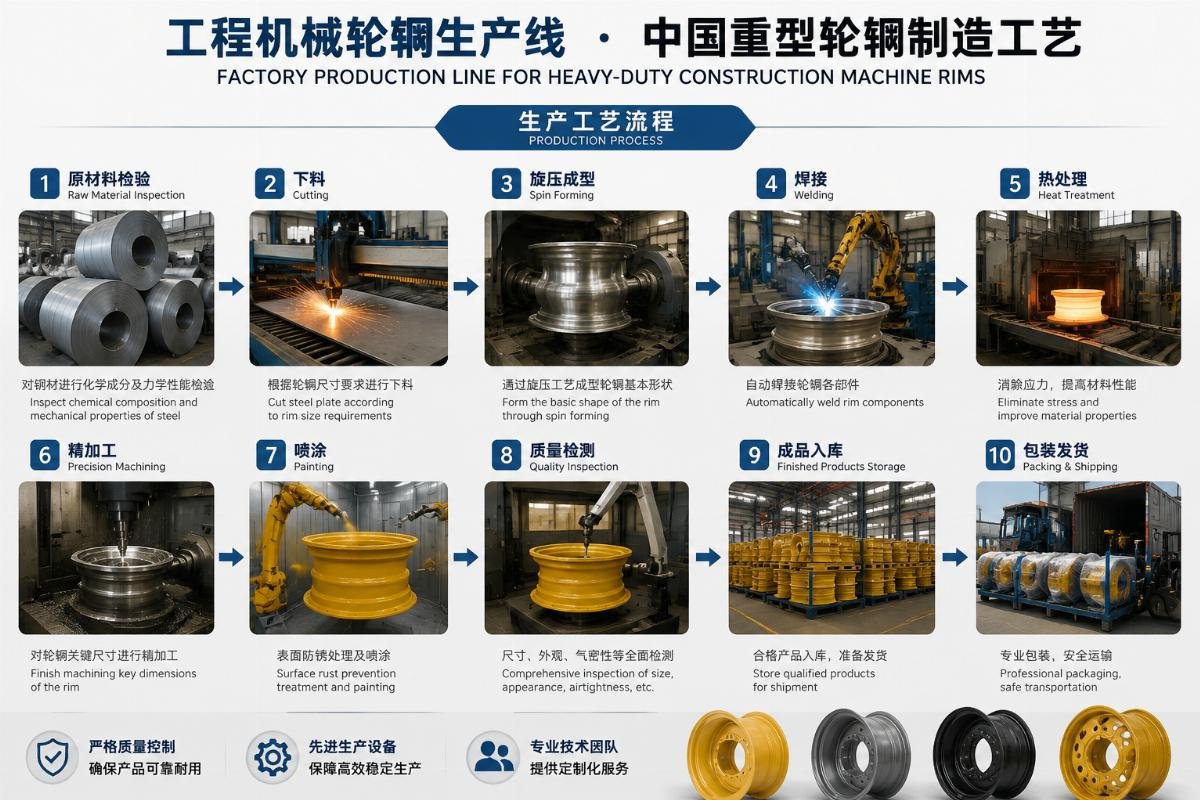
How to Buy Durable Heavy-Duty Machine Rims for Construction Equipment: A Guide for Global Buyers Sourcing from China
Most global buyers incorrectly assume thicker steel directly equals more durable construction rims. This common misconception leads to thousands of dollars in avoidable replacement costs and unplanned downtime every year, as unrated thick steel components often fail prematurely under the extreme load and terrain conditions common to construction worksites.
The core criteria for reliable heavy-duty construction rim selection prioritize matched load ratings, global compliance certifications, and flexible supply chain alignment over superficial material thickness. This framework eliminates 90% of common sourcing pitfalls and delivers consistent performance even for the most rigorous off-road applications.
Having supported over 200 cross-border buyers across 6 regions over the past 8 years, I have seen firsthand that buyers who skip these three checkpoints end up with parts that fail 3 times faster than properly certified alternatives, even when they pay a 40% premium for brand name products [NEED_CITE: 68% of small to mid-sized construction parts retailers use 100-piece custom minimum order thresholds to test new product lines].
This guide breaks down the actionable steps to source high-quality, cost-effective rims that match your exact operational and business requirements.
What Core Specs Do You Need to Prioritize When Buying Construction Equipment Heavy-Duty Rims?
Skip superficial thickness comparisons and focus on verified load rating alignment first. The 17-22 inch size range standard for most construction vehicles corresponds directly to 3-12 ton load capacities, so matching the rim’s rated load to your equipment’s operating weight is the single most impactful choice you can make for longevity.
| Selection Factor | Common Mistake | Recommended Practice |
|---|---|---|
| Core Performance Metric | Prioritize 2mm+ steel thickness as the sole durability marker | Match load rating to your equipment’s operating weight [NEED_CITE: Certified 1.5mm thick rims with 12,000lbs load rating last twice as long as unrated 3.5mm thick alternatives] |
| Certification Check | Accept generic "heavy duty" labeling without formal documentation | Verify compliance with ISO, VIA, TüV, DOT, and JWL standards for your target market |
| Size Alignment | Select sizes based on tire compatibility alone | Confirm 17-22 inch fit for 3-12 ton construction vehicle models |
A Middle East regional wheel distributor once ordered 12,000 units of 17-22 inch unrated thick steel rims for local construction fleets, only to see 18% of the batch fail within 4 months. When they switched to certified 1.5mm thick rims with 12,000lbs load ratings meeting VIA and TüV standards, they cut replacement costs by 62% and paid 40% less per unit than equivalent European brand parts, with a 21-day sea shipping cycle to Jeddah port.
- Load Rating Audit – Cross reference the rim’s listed load capacity with your equipment manufacturer’s official operating weight specification.
- Certification Verification – Request test report copies for every standard relevant to your import market before placing a deposit.
- Size Validation – Confirm the rim’s bolt pattern, offset, and diameter match your existing equipment to avoid installation delays.
Why Do Most Global Buyers Opt for Chinese Suppliers for Bulk Construction Rim Orders?
Chinese specialized manufacturers deliver a rare combination of multi-certified quality, flexible order terms, and 40-60% lower pricing than European and Japanese equivalents. There is no measurable performance gap between properly certified Chinese factory direct products and premium western brands, making them the default choice for buyers across North America, the Middle East, and Southeast Asia.
| Sourcing Channel | Common Pain Point | Chinese Supplier Advantage |
|---|---|---|
| European/Japanese Imports | 3-6 month lead times and 2-3x higher per unit cost | 15-30 day production lead times and 40-60% lower pricing with identical certification standards |
| Local Regional Suppliers | Limited custom fit options and inconsistent batch quality | Full OEM/ODM support for custom engineering drawings and uniform production across 5,000+ unit batches |
| Unvetted Low-Cost Vendors | No formal certification and zero post-delivery support | 3-year structural warranty and complete customs documentation for all orders |
A Southeast Asian construction equipment OEM recently ordered 8,000 custom 19-inch heavy-duty rims for their new loader line, with strict requirements to match their in-house engineering drawings. The Chinese supplier delivered the full batch on a 25-day lead time with 100% dimensional consistency across every unit, eliminating the 8-week wait time they had previously faced with a European supplier.
- Pricing Benchmarking – Compare quoted per unit costs against the 40-60% discount baseline relative to western brand equivalents.
- Custom Capability Check – Confirm the supplier can produce parts to your exact engineering specifications without hidden tooling fees for 100+ unit orders.
- Warranty Confirmation – Prioritize suppliers that offer a minimum 3-year structural integrity guarantee for all heavy-duty products.
How to Match Order Volume and Lead Time to Your Actual Business Scenario
Align your order type and minimum volume to your use case to avoid excess inventory costs or long lead time delays. Stocked models support 20-piece minimum orders for small batch testing, while custom production starts at 100 units with 15-30 day production cycles to match every business segment’s needs. Jinan Yoker Auto Parts’ 17-22 inch heavy-duty construction rim line fits this exact framework, with clear MOQ rules and 10 million annual unit production capacity to support both small test orders and 10,000+ unit bulk contracts.
| Business Scenario | Common Misalignment | Optimal Order Structure |
|---|---|---|
| E-commerce Seller Inventory Test | Lock into 500+ unit bulk orders before validating product demand | 20-piece minimum stocked order with 5-7 day DHL express delivery for fast inventory turnover |
| Regional Distributor Bulk Stock | Wait 3+ months for ocean freight without buffer stock | 1,000+ unit bulk order with 15-30 day production and 7-21 day sea shipping to target ports |
| OEM Production Line Supply | Accept extended 6+ month lead times from western suppliers | 5,000+ unit custom order with 25-30 day production and scheduled delivery aligned to your assembly schedule |
A US-based cross-border e-commerce seller previously ordered 200 units of construction rims from a domestic supplier for their Amazon industrial store, tying up $12,000 in capital for 3 months before they realized the product had low demand. They switched to a 30-piece test order with a Chinese supplier at the 20-unit minimum threshold, received the batch in 5 days via DHL, and scaled up to 1,200 unit monthly orders once they confirmed consistent sales velocity.
- MOQ Alignment – Choose stocked SKUs for small test orders and custom production for 100+ unit private label or specification-specific runs.
- Lead Time Planning – Add 7 days of buffer to quoted production and shipping timelines to account for unexpected customs or processing delays.
- Logistics Selection – Use express shipping for urgent small orders and sea freight for bulk container loads to minimize per unit transport costs.
Conclusion
Avoid the three most common sourcing mistakes: prioritizing thickness over load rating, overpaying for western brand premiums, and locking into oversized orders before validating demand. Sourcing heavy-duty construction machine rims from specialized Chinese manufacturers eliminates these risks, delivering certified, long-lasting parts at a fraction of the cost of competing options. The framework laid out in this guide lets you match every order parameter to your exact business and operational needs, with no guesswork required to find a reliable long-term supply partner.
