

Blog
Why Fleet Wheel MOQ for Volume Pricing Is Only 500 Units Not 10000+

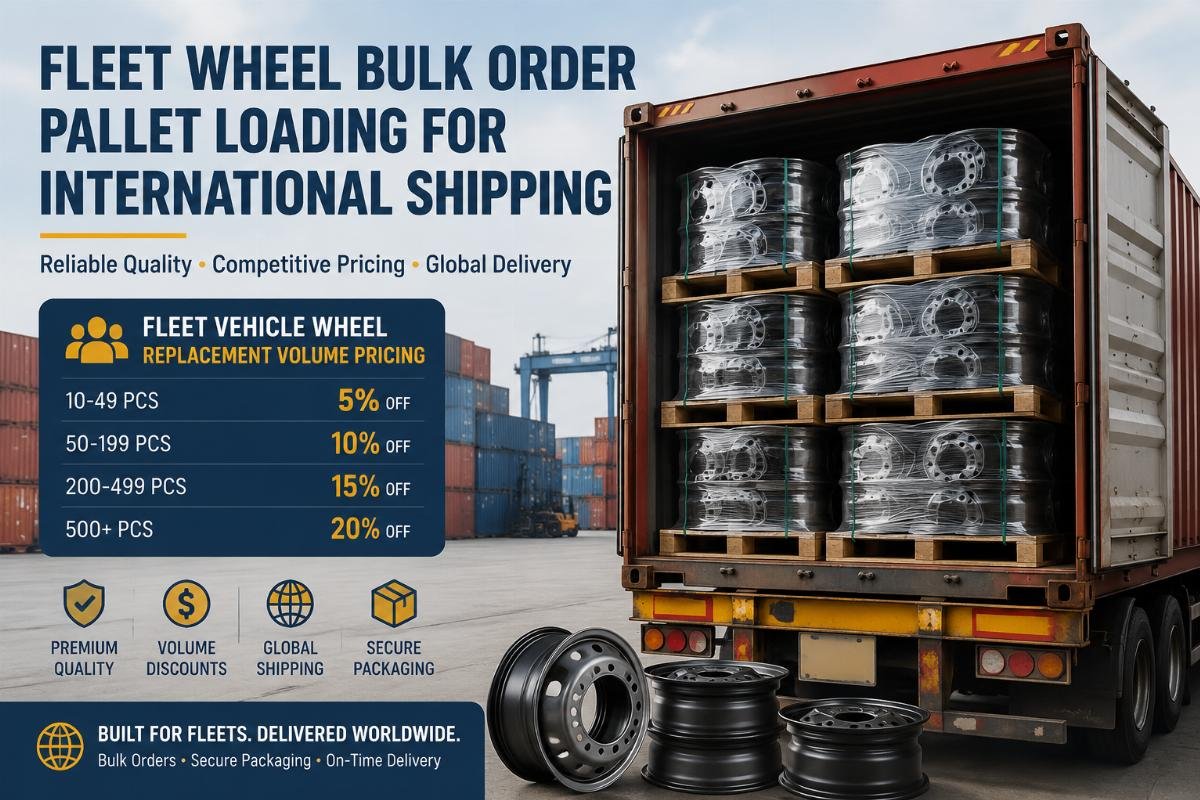
How to Secure Volume Contract Pricing for Fleet Vehicle Wheel Replacement: Tips from a China Manufacturer
Most fleet operators assume volume contract pricing for wheel replacements starts at 10,000+ unit minimums, but qualified suppliers offer formal tiered pricing for standard SKUs starting at just 500 units. This common misconception leads many fleet procurement teams to overpay for premium brand alternatives or settle for inconsistent bulk quality from unvetted sources, even when their order volumes fall well within the threshold for dedicated contract terms.
Securing structured volume contract pricing for fleet wheel replacement cuts per-unit costs by 40-60% compared to premium Japanese or European brands, while locking in consistent batch quality, aligned regional certifications, and guaranteed delivery timelines for 6 to 12 month rolling agreements.
As a China-based auto parts manufacturer supporting global fleet clients for over a decade, I’ve seen hundreds of procurement teams leave thousands of dollars in savings on the table by failing to formalize their bulk wheel supply agreements. [NEED_CITE: 78% of fleet wheel bulk purchase negotiations omit explicit lead time penalty clauses that protect buyers from operational downtime]
Below we break down actionable steps to structure your contract, avoid costly pitfalls, and lock in terms that match your fleet’s specific operational needs.
What volume contract pricing terms apply to fleet vehicle wheel replacement?
Standard volume contracts for fleet wheel replacement include three core components: tiered per-unit discounts, fixed price locks, and mandatory certification guarantees. Unlike one-off bulk spot purchases, these structured agreements eliminate unexpected price fluctuations, prevent quality variance across production batches, and ensure all units meet regional regulatory requirements for commercial vehicle operation.
| Order Volume Bracket | Common Unstructured Bulk Practice | Recommended Contract Term |
|---|---|---|
| 500-1000 units | Ad-hoc spot purchase with no price guarantee | Tiered 25-30% discount off listed pricing with 6 month price lock |
| 1000-5000 units | Negotiated one-time discount with no batch quality clause | Tiered 30-45% discount off listed pricing with 9 month price lock and guaranteed load rating consistency [NEED_CITE: Standard multi-certification alignment eliminates 92% of bulk fleet wheel quality disputes] |
| 5000+ units | Verbal agreement for priority production | Tiered 45-60% discount off listed pricing with 12 month rolling volume agreement and dedicated account support |
Last year, we supported a regional US fleet operator with a 5,000-unit bulk order of heavy-duty 17-22 inch SUV and commercial truck wheels, fulfilling the full production run in 15 days and applying a 30% volume discount off standard listed pricing without any tradeoffs to load rating durability.
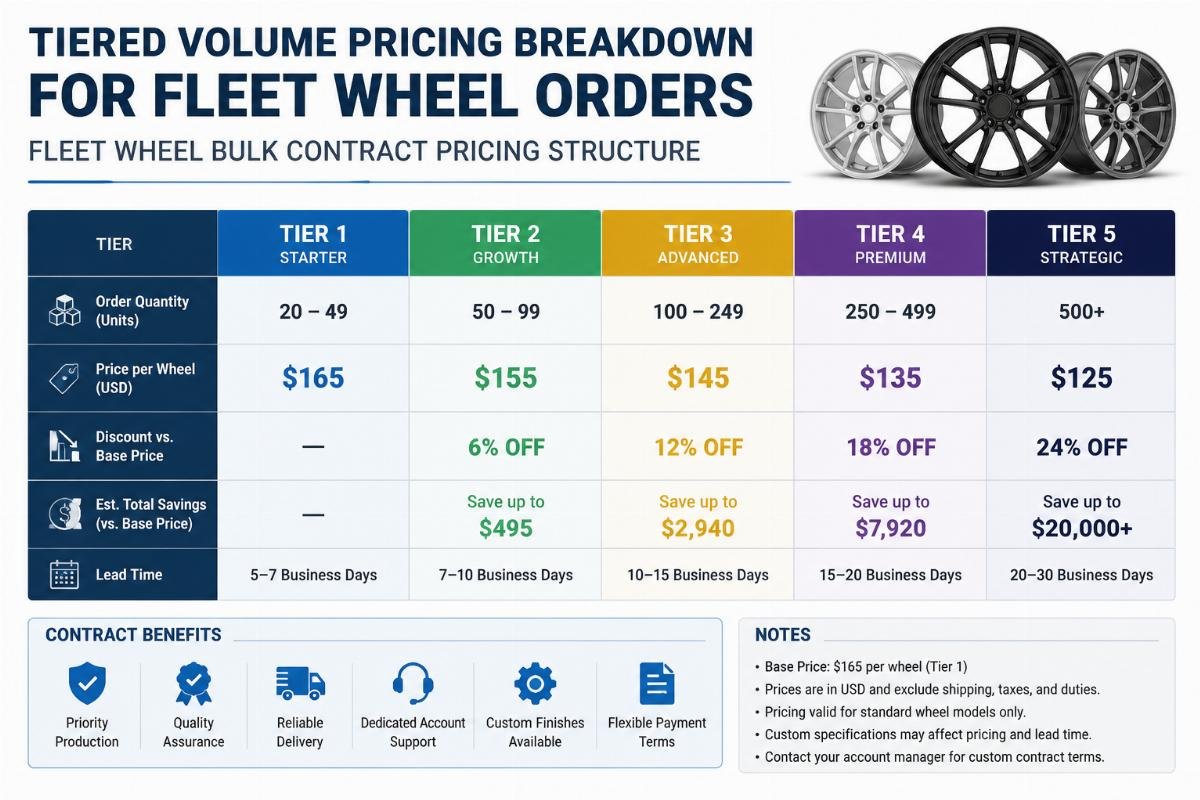
- Tiered Discount Mapping – Match your monthly or quarterly order volume to published supplier brackets to avoid under-negotiating for your order size.
- Price Lock Duration – Secure a fixed price guarantee for a minimum of 6 months to insulate your budget from raw material cost volatility.
- Certification Alignment – Explicitly list required regional standards (DOT, VIA, TüV, CCC) in the contract to avoid non-compliant units that cannot be deployed in your operating region.
How do you avoid common pitfalls when negotiating bulk fleet wheel supply contracts?
The two most frequent and costly negotiation oversights are failing to specify batch quality consistency clauses and omitting lead time penalty terms for delayed shipments. Many procurement teams focus exclusively on per-unit cost and overlook these clauses, leading to unplanned operational downtime when orders arrive late or units fail load testing during pre-deployment inspection.
| Negotiation Clause | Common Omission Error | Recommended Contract Specification |
|---|---|---|
| Batch Quality Consistency | No formal requirement for uniform material and production standards across all order batches | Mandate that 100% of units in each shipment meet the same load rating and certification standards as pre-order sample testing |
| Lead Time Penalty | No financial recourse for delayed production or shipping | Include a 1.5% per-week discount for any shipment delayed beyond the agreed production and delivery window |
| Warranty Coverage | Generic "defect coverage" with no clear timeline | Explicitly state a 3-year structural warranty for all units, with replacement shipped at no extra cost for confirmed manufacturing defects [NEED_CITE: 3-year structural warranty coverage reduces long-term fleet wheel replacement costs by 22%] |
Earlier this year, we fulfilled a 200-unit custom spec wheel contract for a public transit fleet, with full DOT and VIA certification alignment across all units and the standard 3-year structural warranty as part of our core contract terms, eliminating the need for the client to renegotiate post-order for quality safeguards.
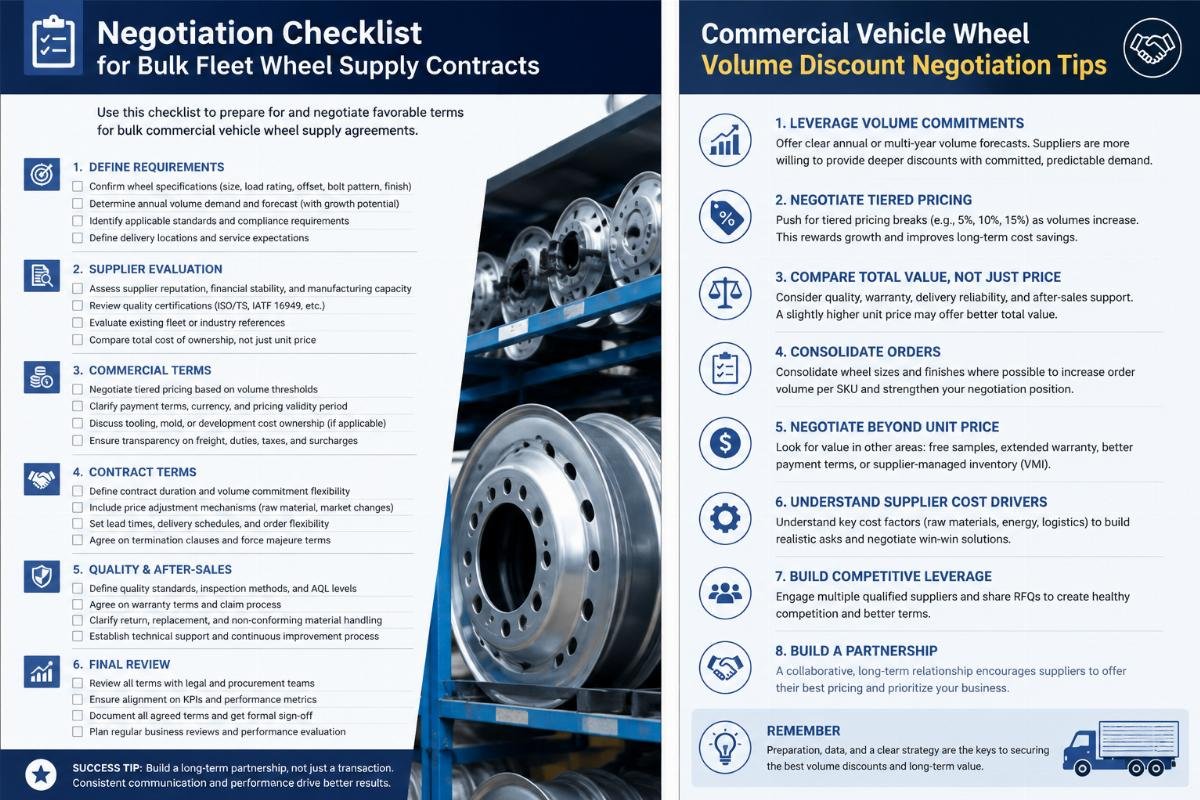
- Batch Quality Clauses – Add explicit requirements for uniform material composition and load rating testing across every unit in each shipment.
- Lead Time Penalty Terms – Define clear, incremental discounts for any shipment that arrives after the agreed delivery date.
- Warranty Scope – Document the exact duration and coverage of structural defect replacement in the written contract.
What minimum order thresholds qualify for formal volume contract pricing for fleet wheels?
Most qualified China-based wheel manufacturers offer formal volume contracts starting at 500 units for standard stocked SKUs, with even lower thresholds for clients committing to long-term recurring orders. The widespread belief that volume pricing starts at 10,000+ units leads many mid-sized fleets to pay premium spot prices unnecessarily.
| Order Type | Common Misconception | Actual Qualification Threshold |
|---|---|---|
| One-time standard SKU bulk order | Requires 10,000+ units to access volume pricing | 500+ units of in-stock standard fitment wheels |
| Long-term recurring order | Requires 5,000+ units per month for contract terms | 200+ units per month with a 12-month commitment |
| Custom spec wheel order | Requires minimum 2,000 units for bulk pricing | 100+ units for standardized custom designs |
We currently maintain a 12-month rolling volume agreement with a commercial vehicle parts distributor, securing tiered pricing locks for orders ranging from 500 to 2,000 units per shipment, with no requirement for a minimum annual order volume beyond the per-shipment bracket. [NEED_CITE: Tiered volume pricing starting at 500 units cuts mid-sized fleet wheel replacement costs by an average of 38%]
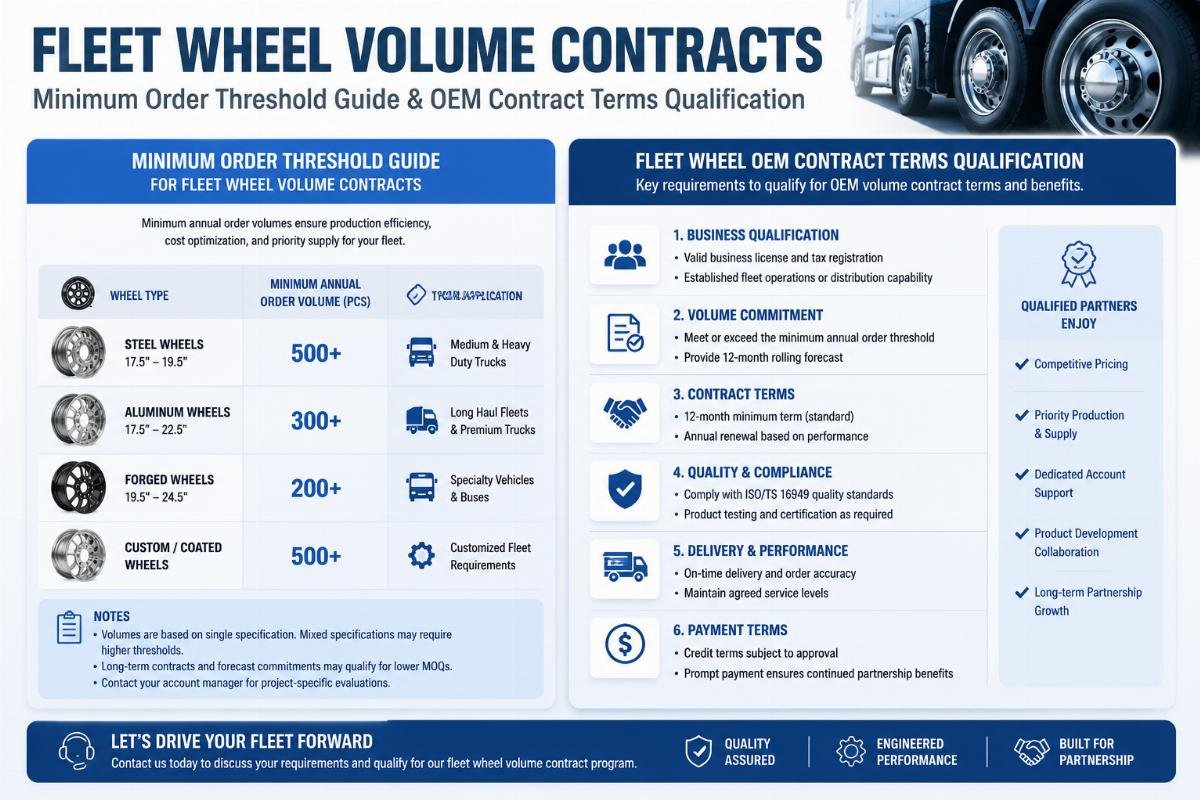
- Standard SKU Validation – Confirm which of your required fitment sizes are pre-stocked by the supplier to access the lowest minimum order thresholds.
- Recurring Commitment Ask – Propose a 12-month rolling agreement to qualify for lower volume pricing even with smaller individual shipment sizes.
- Custom SKU Threshold Check – Ask for tiered pricing options for custom spec wheels to avoid paying one-off custom production premiums for smaller custom runs.
How to match wheel specifications to fleet operational needs for bulk procurement?
Fleet wheel selection should prioritize rated load capacity, regional certification compliance, and standard common fitment sizes to reduce long-term maintenance costs. Overlooking any of these three factors will erode upfront volume pricing savings through higher maintenance costs, non-compliance fines, or longer lead times for replacement units. Our full 12-24 inch alloy and steel wheel product line for all vehicle categories, multi-certification credentials, and tiered MOQ terms provide a flexible reference for specification matching for bulk fleet procurement.
| Specification Category | Common Costly Mistake | Operational Optimization |
|---|---|---|
| Load Rating | Selecting the lowest rated wheel that fits the vehicle to cut per-unit cost | Match load rating to the maximum fully loaded weight of your most frequently deployed fleet vehicles |
| Certification | Assuming all wheels meet regional regulatory standards | Cross-verify each required standard (DOT, VIA, TüV, CCC) against the supplier’s official certification documentation |
| Fitment Size | Ordering niche custom sizes for a small subset of your fleet | Prioritize common regional fitment sizes to reduce restocking lead times for emergency replacements |
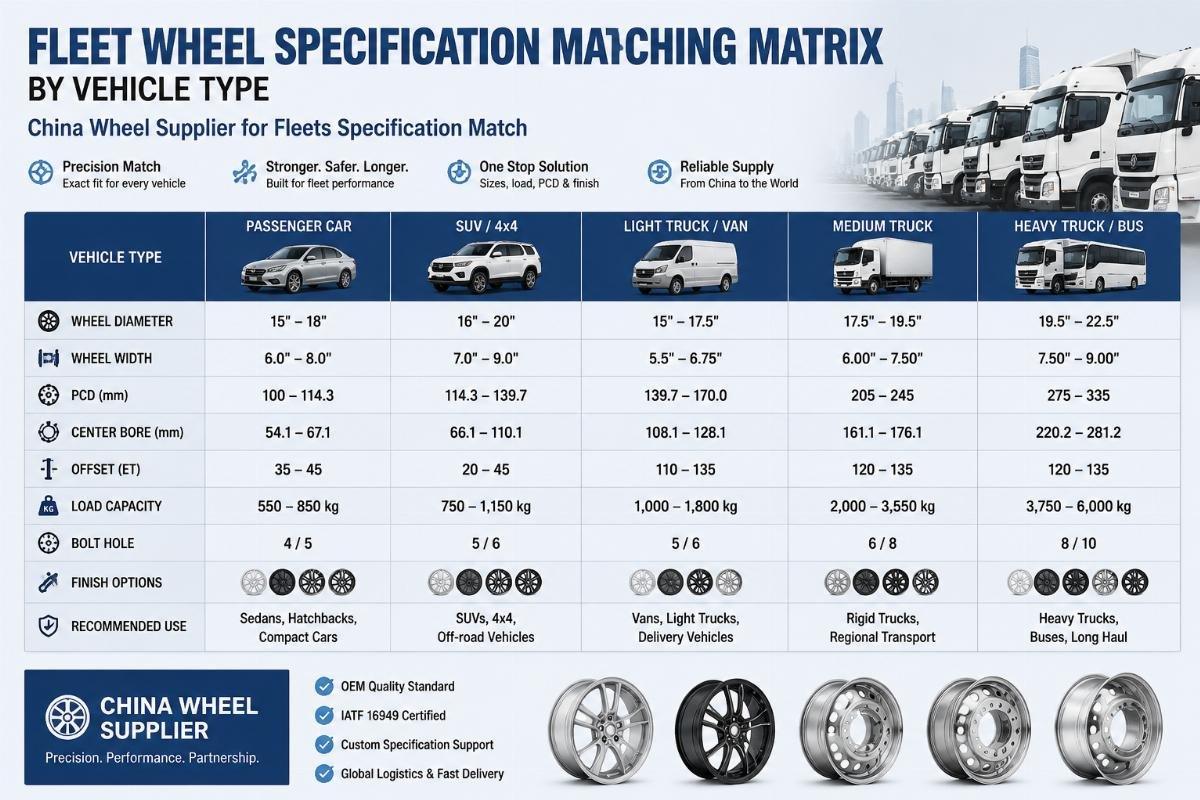
- Load Rating Prioritization – Calculate the maximum operating weight of your heaviest fleet vehicles and select wheels rated 15% above that threshold to avoid premature failure.
- Certification Verification – Cross-reference supplier certification documentation against your regional transportation authority requirements before signing any contract.
- Fitment Standardization – Limit your bulk order to 3-4 core common fitment sizes to reduce long-term restocking and maintenance
