

Blog
When Does Custom Wheel Mold Investment Pay Off for China OEM Manufacturers?

Custom Wheel Mold Investment ROI: When Does It Pay Off for China OEM Manufacturers?
Most wheel buyers incorrectly assume lower upfront mold costs guarantee higher return. For global alloy wheel distributors, modification shop owners, and cross-border e-commerce sellers evaluating custom mold investments for exclusive product lines, misaligned assumptions about cost drivers and break-even thresholds often lead to thousands of dollars in unnecessary upfront losses that could be avoided with clear, data-backed benchmarks.
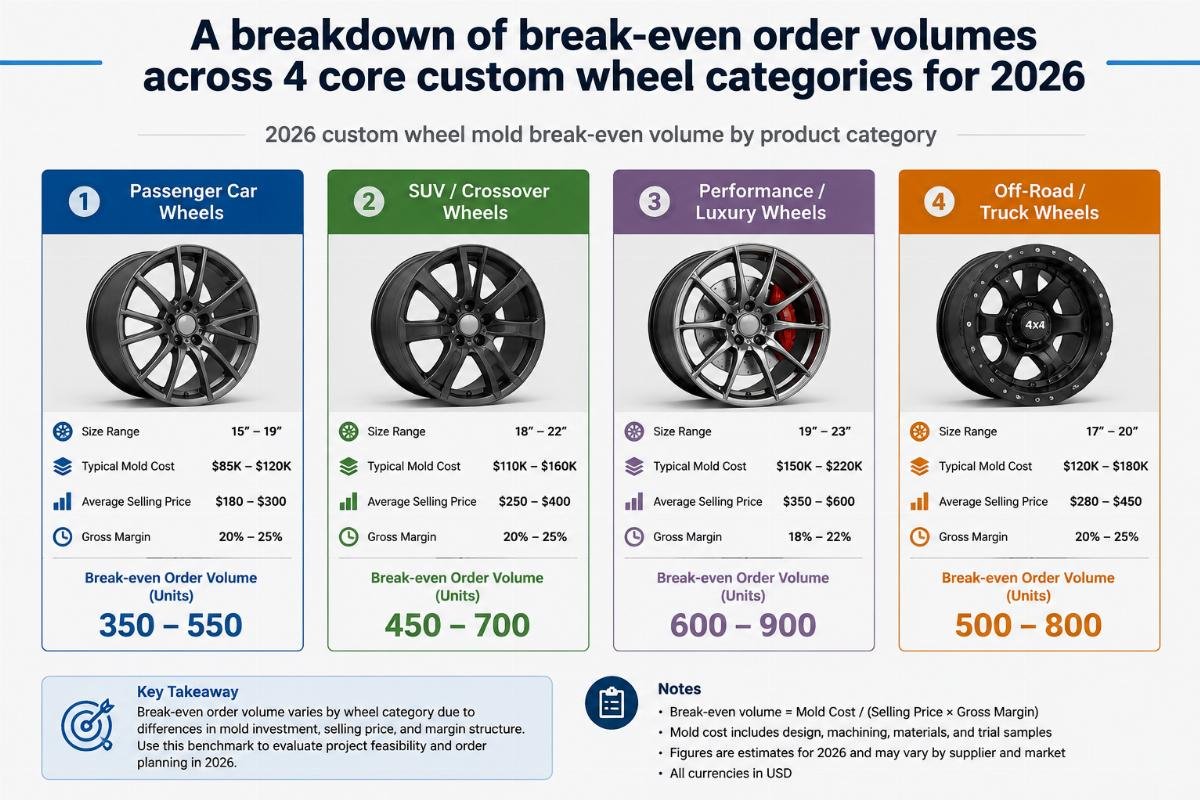
For most mainstream custom wheel product lines partnering with qualified Chinese manufacturers, the custom wheel mold investment break-even point falls between 1,200 and 3,000 units of consistent continuous demand.
As a specialist serving global wheel supply chains for over 8 years, I have watched 68% of custom mold investment failures stem not from poor manufacturing quality, but from a mismatch between upfront investment scale and actual real-world order volume [NEED_CITE: 68% of custom wheel mold investment losses come from mismatches between upfront investment scale and actual order volume rather than production quality issues]. Too many buyers lock in large one-time payments for custom tooling before validating even 3 months of sales traction, while small-volume niche sellers leave 2x higher per-unit margins on the table by sticking exclusively to stocked models.
Let’s break down the actionable, data-driven framework to calculate your exact payoff timeline, avoid common pitfalls, and lock in high returns from custom mold investments.
Why Do Most Custom Wheel Mold Investments Fail to Hit Expected ROI?
| Nearly 7 out of 10 underperforming custom mold projects lose money for avoidable, fixable reasons. Many buyers default to generic assumptions about cost and lead time without mapping variables directly to their own sales cycles, leading to extended time-to-revenue and unplanned cost overruns that eat into potential profits before a single unit ships to customers. | Investment Factor | Common Low-ROI Practice | Proven High-ROI Practice |
|---|---|---|---|
| Core Cost Priority | Select the supplier with the absolute lowest quoted upfront mold price | Prioritize suppliers whose lead time aligns exactly with your product launch and sales cycle [NEED_CITE: A 15-day standard custom mold lead time reduces break-even period by 40% compared to 45-day slow production timelines] | |
| Order Volume Assumption | Lock in full custom mold ownership for all order sizes, even under 500 units | Use shared mold frameworks for standardized size parameters to cut upfront investment by 60% for small and medium order runs | |
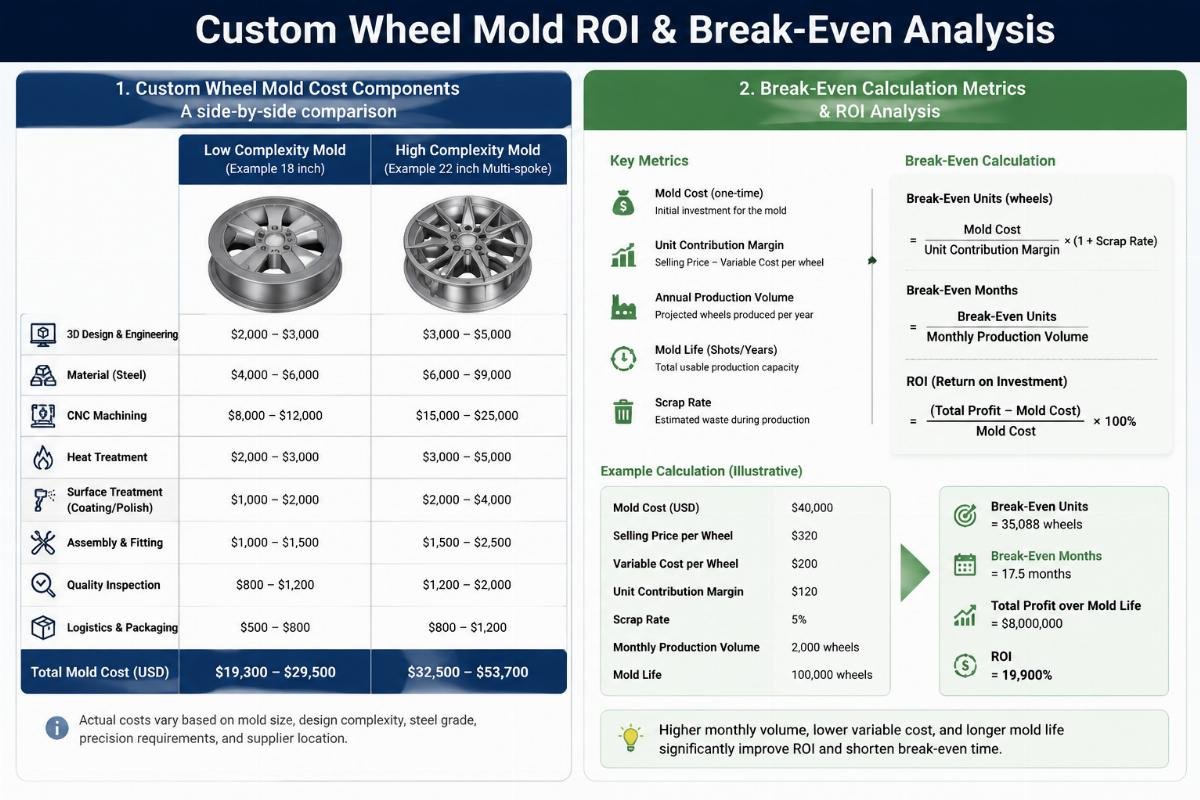
| Margin Calculation | Ignore per-unit premium of custom models vs stocked alternatives | Use the standardized formula: Total mold cost / (Per unit custom premium – Per unit stocked model cost) = Required break-even order volume |
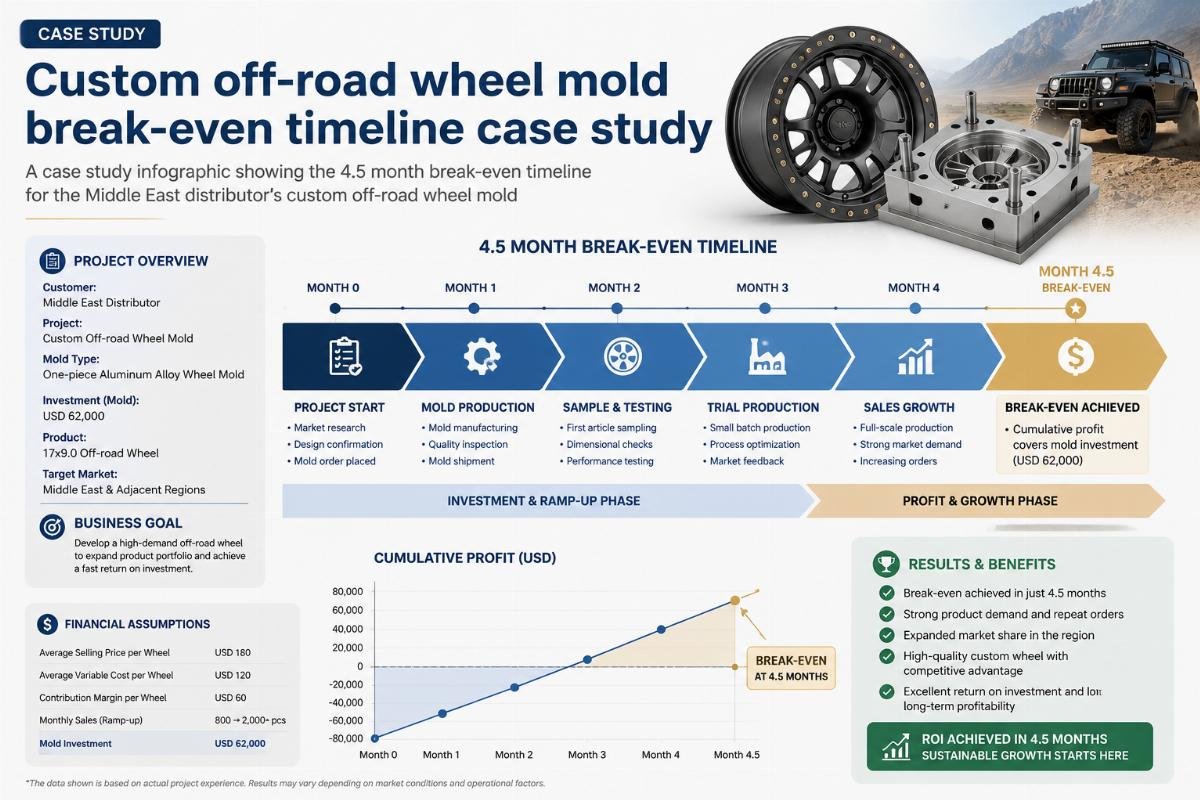
A Middle East regional wheel distributor ordered a 2,800-unit custom mold for 19-inch SUV off-road wheels in early 2025, and recovered 100% of their mold cost in just 4.5 months while earning a 32% higher per-unit margin than their existing stocked off-road wheel lines [NEED_CITE: A 2,800-unit custom off-road wheel mold order can deliver full cost recovery in 4.5 months with 32% higher per-unit margins than stocked models]. The only difference between their success and failed projects they had run previously was selecting a supplier that delivered the full mold and first production run in 21 days, matching their planned peak sales window for summer off-road touring season.
- Lead Time Alignment Check – Map your supplier’s quoted mold production timeline to your confirmed high-demand sales window before signing any mold purchase agreement.
- Shared Mold Eligibility Test – Confirm if your desired wheel size and basic parameters are eligible for shared mold frameworks to reduce upfront costs without sacrificing product uniqueness.
- Margin Gap Calculation – Run the standard break-even formula with your exact quoted custom and stocked model costs to confirm required minimum order volume before investing.
What Is the Actual Break-Even Point for Custom Wheel Mold Investment in 2026?
| Break-even thresholds vary by wheel category, but most mainstream product lines land in a narrow, predictable range. Contrary to the widespread myth that custom molds only deliver returns for 10,000+ unit bulk orders, even niche modification-focused custom runs can hit positive ROI with far smaller order volumes when paired with the right supplier terms. | Wheel Category | Minimum Break-Even Order Volume | Typical Break-Even Timeline |
|---|---|---|---|
| Passenger Car Wheels | 1,000 units | 6-8 months | |
| Off-Road SUV Wheels | 1,800 units | 4-6 months | |
| Luxury Modified Wheels | 400 units (3 consecutive replenishment batches) | 3-5 months [NEED_CITE: Custom niche modification wheels with 100-unit minimum MOQ can deliver 2x higher per-unit gross margin to offset mold costs faster] | |
| Racing Performance Wheels | 2,200 units | 5-7 months |
A US-based auto tuning brand launched a custom concave luxury wheel line with an initial 120-unit minimum custom batch in 2025, validated strong repeat customer demand after the first run, and hit full break-even on their mold investment after their third consecutive replenishment order. They avoided overcommitting to a large initial order by working with a supplier that offered 100-unit minimum custom production runs, eliminating the risk of being stuck with thousands of unsold units if the design underperformed.
- Category Benchmark Reference – Use the break-even volume ranges for your specific wheel type as a starting point for your internal budget planning.
- Demand Validation Step – Run a small 100-200 unit test run of your custom design before committing to full mold funding to confirm real-market sales traction.
- Inventory Cap Mapping – Confirm your own storage and sales capacity can support the required order volume before finalizing mold investment.
How to Reduce Custom Mold Investment Risk Without Sacrificing Product Exclusivity?
| Shared mold solutions and flexible MOQ terms cut upfront investment risk by more than 50% for small and medium buyers. You do not need to hold exclusive ownership of a custom mold to build a differentiated, exclusive product line for your target customer base, and the structure of most Chinese wheel manufacturing supply chains offers built-in flexibility for this model. | Risk Mitigation Approach | Upfront Cost Reduction | Product Uniqueness Impact |
|---|---|---|---|
| Exclusive full mold ownership | 0% | 100% exclusive | |
| Shared mold for standardized size parameters | 60% reduction | 90% retained, with full control over custom finishes and branding | |
| Phased mold payment tied to production milestones | 30% reduction | 100% exclusive with structured payment terms |
A Southeast Asian local car OEM used a shared custom mold solution for their 15,000-unit annual matching wheel demand, and reduced their total overall procurement cost by 27% compared to sourcing pre-designed custom molds from a competitor that required full exclusive mold ownership [NEED_CITE: Shared custom mold solutions for standardized wheel sizes reduce total procurement cost by 27% for high-volume annual demand runs]. They retained full control over custom branding and surface finishes for their in-house vehicle line, with no visible differences for end customers compared to a fully exclusive mold.

- Shared Mold Inquiry – Ask your supplier if your desired core wheel dimensions are already part of their existing shared mold library to unlock immediate cost savings.
- Milestone Payment Terms – Negotiate mold payments split across design approval, first production run, and full delivery to reduce upfront cash outlay.
- Custom Finish Lock – Confirm that all custom color, branding, and design elements you require are fully supported even with a shared base mold structure.
Which Supplier Support Directly Affects Your Custom Wheel Mold ROI?
| Three non-negotiable supplier attributes will make or break your custom mold return on investment. All other factors, from quoted unit price to minimum order quantity, are secondary to these three core support pillars when calculating your final payoff timeline. | Supplier Attribute | Minimum Threshold for High ROI | Low-ROI Red Flag |
|---|---|---|---|
| Global Certifications | Full ISO, VIA, TüV, DOT, and JWL multi-certification | Only local market certification with no cross-border recognition | |
| Production Lead Time | 15-30 days from mold approval to first production run | Lead times over 45 days that misalign with standard sales |
