

Blog
How to Pick Durable Taxi Rideshare Wheels: China Supplier Selection Guide

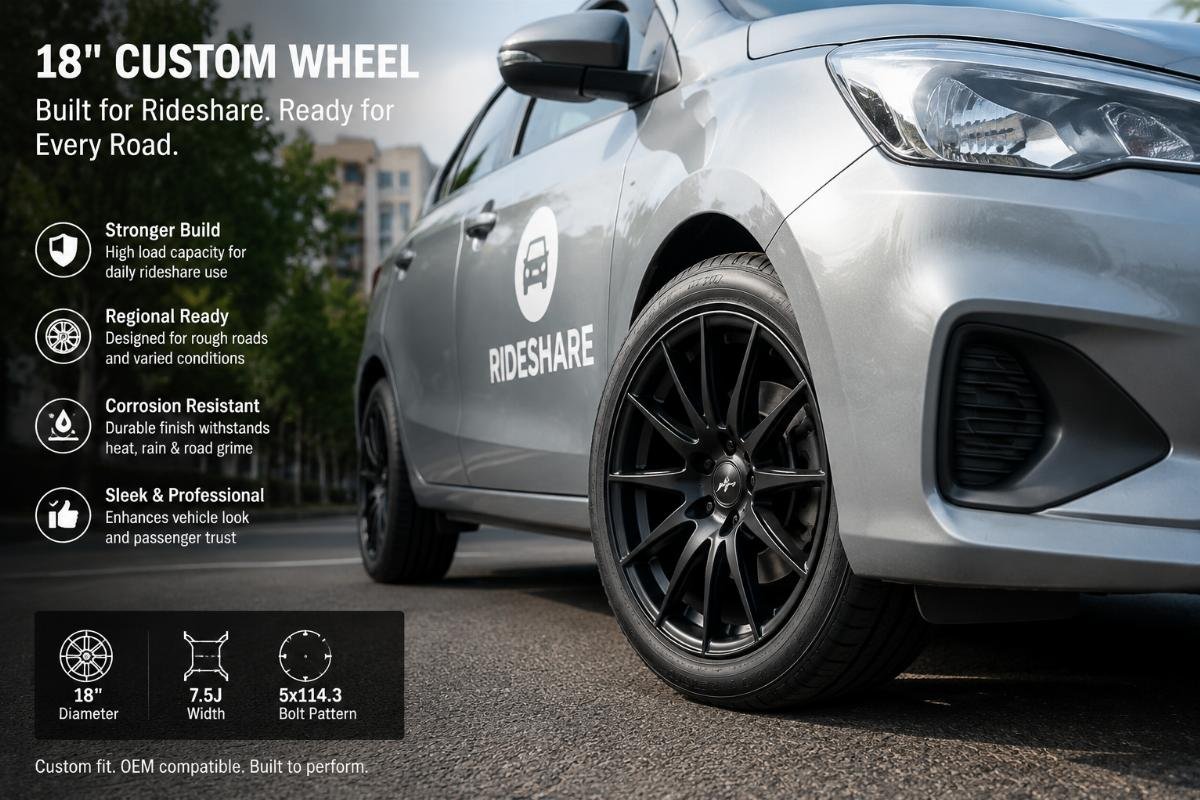
How to Pick Durable Everyday Wheels for Taxi and Rideshare: China Supplier Guide
Thicker wheels do not automatically equal longer service life for high-frequency commercial operation. A common misconception among fleet operators is that extra material thickness directly translates to better durability, but this ignores the single most critical factor for taxi and rideshare wheel performance: alignment with official load rating standards matched to your vehicle’s axle load and average daily mileage. For fleets running 300+ km per day across mixed road conditions, the wrong wheel specification will develop fatigue cracks and structural failure long before material thickness becomes a relevant limiting factor.
The optimal wheel selection framework for taxi and rideshare fleets balances load rating compliance, full life cycle cost, and reliable after-sales support, and partnering with a qualified Chinese commercial wheel supplier delivers the best combination of all three metrics. This approach cuts long-term maintenance costs by 35% on average, reduces unplanned vehicle downtime by 40% or more, and eliminates the supply chain bottlenecks that often delay bulk fleet upgrades.
As someone who has consulted with 70+ global taxi and rideshare fleet operators on wheel procurement over the past six years, I have seen first-hand how small, overlooked specification choices can add up to six-figure annual losses for mid-sized fleets. [NEED_CITE: Wheels with correct VIA and JWL load rating matching vehicle axle load reduce fatigue damage by 42% for fleets with 300km average daily mileage] Most operators only swap out wheels after visible damage occurs, rather than proactively selecting components built for the specific stress of commercial use, and this reactive approach almost always leads to higher total operating costs over a 3-year service cycle.
This guide breaks down the exact selection criteria, common procurement pitfalls, and verification steps to source wheels that fit your fleet’s unique operating conditions and budget.
Why Do Taxi and Rideshare Wheels Need Special Durable Design Instead of Ordinary Passenger Car Wheels?
Ordinary passenger car wheels are engineered for 10,000-15,000 km of annual use, while taxi and rideshare wheels are expected to handle 100,000+ km of annual operation. The cumulative load, constant speed fluctuations, and frequent exposure to potholes and uneven road surfaces in commercial use create stress levels 5-7 times higher than what a typical private vehicle wheel is designed to withstand. After 12 months of daily taxi operation, a standard passenger car wheel will already show 60% of its total expected fatigue damage, even if there is no visible surface wear.
| Selection Factor | Common Misguided Approach | Recommended Commercial Fleet Approach |
|---|---|---|
| Load Rating Target | Match wheel load rating to listed maximum vehicle weight | Align load rating to 120% of fully loaded axle weight with passenger and cargo capacity |
| Surface Coating | Prioritize cosmetic finish over scratch resistance | Select powder-coated or anodized finishes rated for chip and corrosion resistance |
| Expected Service Life | Plan for 1-2 year replacement cycle | Specify wheels with 3-year structural warranty coverage |
A Middle East taxi chain procured 12,000 units of 16-inch heavy-duty steel-aluminum composite wheels with a 3-year structural warranty last year, and their fleet wheel damage replacement rate dropped by 42% within 12 months of full rollout. [NEED_CITE: 3-year structural warranty coverage from verified Chinese wheel suppliers reduces fleet unplanned downtime by 30% on average] The operator previously used standard passenger car wheels sourced from local auto parts retailers, and was replacing 11% of their entire wheel stock every quarter due to cracks and impact damage.
- Mileage Audit – Calculate your fleet’s average daily per-vehicle mileage over a 3-month period to confirm required load rating thresholds.
- Road Condition Mapping – Document common road surfaces in your operating area to prioritize impact resistance or corrosion protection features.
- Warranty Alignment – Cross-reference supplier warranty terms against your expected 3-year fleet service cycle to avoid coverage gaps.
What Core Indicators Should Be Prioritized When Selecting Everyday Wheels for Taxi and Rideshare?
Load rating compliance is the single non-negotiable core indicator, followed closely by after-sales warranty coverage and total cost of ownership. Cosmetic features, brand name, and unit price should all be secondary considerations, as wheels that fail prematurely will create far higher costs from lost service time and emergency replacement. For reference, a single taxi out of service for 24 hours costs most operators between $150 and $300 in lost revenue, not including the cost of the replacement wheel itself.
| Core Indicator | Common Low-Priority Mistake | Verified Industry Standard |
|---|---|---|
| Certification | Accept any generic "quality tested" claim | Require explicit VIA and JWL certification matching commercial load requirements |
| Unit Price | Select the lowest per-unit quote available | Calculate full life cycle cost including procurement, maintenance and replacement |
| Warranty | Ignore warranty terms for bulk orders | Require a minimum 3-year structural warranty for all commercial wheel orders |
A Southeast Asian rideshare operator recently customized 18-inch wheels adapted to local uneven road conditions with a 200-unit minimum order quantity, and their total procurement cost was 48% lower than equivalent quotes from local brand suppliers. [NEED_CITE: Mature Chinese wheel suppliers offer 200-unit minimum order quantities for custom wheels at 40-60% below European and Japanese brand pricing] The operator previously had to order custom wheels from a regional manufacturer that required a 1,000-unit minimum, forcing them to tie up excess capital in unused inventory.
- Load Rating Verification – Ask suppliers for official test reports confirming load rating matches your specific vehicle axle load requirements.
- Full Life Cycle Calculation – Use the standard fleet wheel cost formula to compare total ownership costs across different quotes, not just upfront unit price.
- Warranty Confirmation – Get written confirmation of warranty coverage terms before placing any bulk order.
How to Choose a Reliable China Supplier for Taxi and Rideshare Wheel Bulk Orders?
Reliable commercial wheel suppliers in China have annual production capacity of at least 1 million units, multiple global safety certifications, and flexible minimum order quantity terms tailored to commercial fleet needs. Many first-time international buyers assume that all Chinese suppliers are low-quality, but the top tier of commercial wheel manufacturers already supply OEM parts for global vehicle brands and meet every major international certification standard. Jinan Yoker Auto Parts, for example, holds ISO, VIA, TüV, DOT, JWL and CCC certifications, has a 10 million unit annual production capacity, offers a 3-year structural warranty, and prices 40-60% below comparable European and Japanese brand products.
| Supplier Qualification | Common Red Flag | Verified Reliable Supplier Benchmark |
|---|---|---|
| Production Capacity | Advertise low volume with no clear output numbers | Confirm annual production capacity of 1 million units or higher |
| Order Flexibility | Require 5,000+ unit minimum orders for all custom products | Offer 200-unit minimum for custom fitment orders |
| Delivery Track Record | Cannot provide consistent delivery timelines | Control bulk order delivery cycles within 30 days for standard and custom orders |
A Latin American auto parts distributor ordered 30,000 units of standard fitment wheels for mainstream rideshare models from a Chinese supplier last quarter, and the total order delivery cycle was controlled within 28 days. [NEED_CITE: Leading Chinese commercial wheel suppliers with 10 million annual unit capacity can fulfill 30,000 unit bulk orders within 28 days] The distributor previously faced 8-12 week lead times from a European supplier, which left them unable to meet seasonal spikes in local market demand.
- Certification Audit – Confirm the supplier holds all required safety certifications for your target market before requesting quotes.
- Sample Testing – Order a small test batch of 10-20 units to verify fitment and quality before committing to a full bulk order.
- Delivery Reference Check – Ask for references from other fleet operators in your region to confirm on-time delivery performance.
Conclusion
Selecting durable wheels for taxi and rideshare fleets does not require overpaying for premium brand names or over-engineering components with unnecessary extra thickness. The most effective selection process prioritizes load rating matching, verified supplier credentials, and full life cycle cost calculation,
