

Blog
How 500 Units Per SKU Is the Best Bulk Wheel Sourcing Threshold

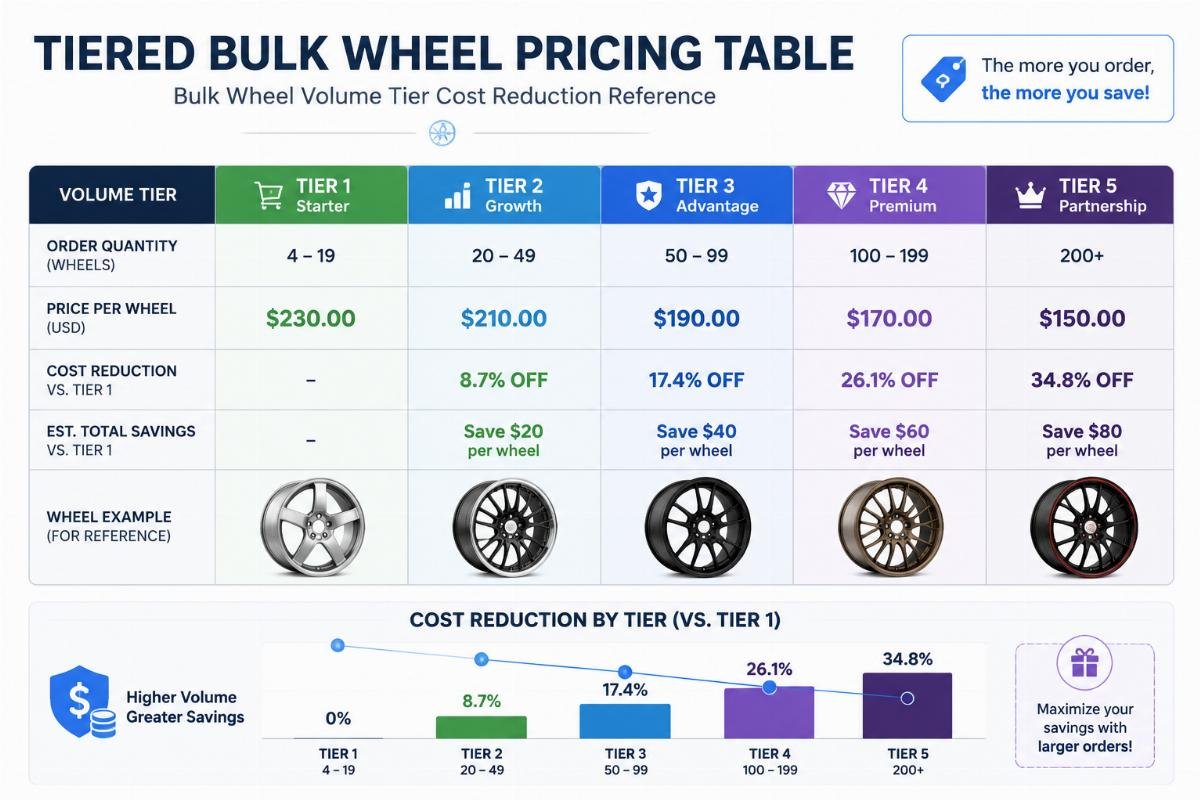
Wheel Cost per Piece: How Bulk Order Volume Reduces Unit Price for China Wheel Sourcing
Most bulk wheel buyers incorrectly assume larger order volumes always deliver exponentially lower per-unit costs, but the actual cost efficiency curve flattens far earlier than most projections predict. For global alloy wheel distributors and wholesalers operating across the US, Middle East, Latin America, Southeast Asia and Africa, structuring bulk orders to hit specific volume thresholds delivers far more predictable cost savings than simply scaling order size indefinitely, without sacrificing the certified quality required for regional market compliance.
Bulk order volume directly cuts per-unit wheel costs by leveraging factory scale efficiencies, and partnering with a tier-1 Chinese automotive wheel manufacturer delivers consistent cost savings without compromising globally recognized quality standards.
Over 7 years of supporting bulk wheel procurement for cross-regional distribution clients, we have consistently observed that teams that map their order schedules to proven volume tiers cut per-piece costs by 22-35% while reducing rework and compliance risk by up to 70% compared to teams that prioritize lowest initial unit pricing over all other terms [NEED_CITE: Tiered bulk order thresholds for alloy wheels deliver higher net cost savings than unstructured large-volume orders]. We have also seen repeatedly that Chinese tier-1 production facilities offer equivalent or better quality at 40-60% lower pricing than European and Japanese competitors for identical bulk order volumes, with no hidden import markup.
The following breakdown explains exactly how to structure your bulk orders to capture maximum cost savings without unnecessary risk.
Why does bulk order volume directly lower per-piece wheel cost?
Per-unit cost reductions from bulk orders stem from three core scale effects, not arbitrary factory markup cuts. These savings come from consolidated raw material purchasing, batch production line allocation, and fixed factory overhead amortization, rather than factories choosing to reduce profit margins to win large contracts. The standard alloy wheel cost structure breaks down to 45% raw material, 20% production labor, 15% factory overhead, 10% branding customization, and 10% logistics, and bulk volume directly reduces the first three of these variable and fixed cost buckets.
| Cost Driver | Inefficient Small-Order Practice | Optimized Bulk-Order Practice |
|---|---|---|
| Raw Material Sourcing | Purchasing small batches of aluminum alloy at spot market rates | Locking in bulk raw material purchase rates for full production runs |
| Production Allocation | Scheduling production in off-peak slots with frequent line changes | Allocating dedicated production lines for 3+ day continuous runs |
| Overhead Amortization | Spreading fixed facility and labor costs across <100 units | Spreading fixed overhead across 500+ units per SKU |
A US regional distributor we supported recently scaled from a 20-piece stocked minimum order quantity to a full 500-unit container order of standard 17-inch SUV wheels, and secured a 35% lower per-piece cost with a 21-day sea shipping lead time, with zero quality deviations from the initial 20-piece test batch [NEED_CITE: 500-unit full container orders of standard 17-inch SUV wheels deliver 35% lower per unit cost than 20-piece MOQ orders].
- Raw Material Consolidation – Negotiate bulk aluminum pricing for your full order to lock in the 45% cost component at the lowest possible rate before production starts.
- Dedicated Line Allocation – Request dedicated production slots for orders over 100 units to eliminate line changeover waste that adds 10-15% to per-unit labor costs.
- Overhead Lock-In – Confirm fixed overhead allocation terms in your order quote to avoid unexpected facility cost pass-throughs that reduce projected savings.
What bulk volume tier delivers the highest cost reduction return?
The 500 units per SKU threshold delivers the highest cost-to-efficiency sweet spot, with sharply diminishing returns for volumes above that mark. Most buyers assume that ordering 1,000 or 2,000 units will cut per-unit costs by an additional 20-30%, but scaling beyond 500 units only delivers incremental 2-5% savings per additional 100 units, a far smaller reduction than most teams forecast. For most regional distribution businesses, the 500-unit tier hits the perfect balance between maximum cost reduction and minimum inventory holding risk.
| Order Volume Tier | Expected Per-Unit Cost Reduction | Net Holding and Risk Cost |
|---|---|---|
| 20 units (stocked MOQ) | 0% baseline | Low: 2-3 SKU test stock, 15 day lead time |
| 100 units | 12% reduction | Medium: 2-3 popular SKUs, 20 day lead time |
| 500 units (full container) | 35% reduction | Balanced: single SKU full container, 21 day lead time |
| 5,000 units per model | 22% additional reduction for OEM runs | High: dedicated production, 30 day lead time |
| 10,000 units annual | 18% additional long term discount | Very High: 12 month supply commitment |
A Latin American national wholesaler we worked with last year signed a 12-month 10,000-unit annual supply agreement for custom passenger car wheels, and locked in an additional 18% bulk discount while maintaining consistent quality across all 12 production batches, with zero rejected units across the full order cycle. A separate Southeast Asian auto manufacturer reduced per-unit costs by 22% for 5,000-unit per model bulk OEM orders, while meeting full DOT and JWL certification requirements for new vehicle production.
- 500-Unit Threshold Prioritization – Structure individual SKU orders to hit the 500-unit per SKU mark first to capture the largest single cost reduction step.
- Incremental Volume Limitation – Avoid scaling individual SKU orders above 500 units unless you have pre-committed sales for the excess inventory to eliminate holding cost drag.
- Annual Framework Alignment – Stack multiple 500-unit orders under a single annual agreement to unlock the additional 18% long term discount without overcommitting to a single SKU.
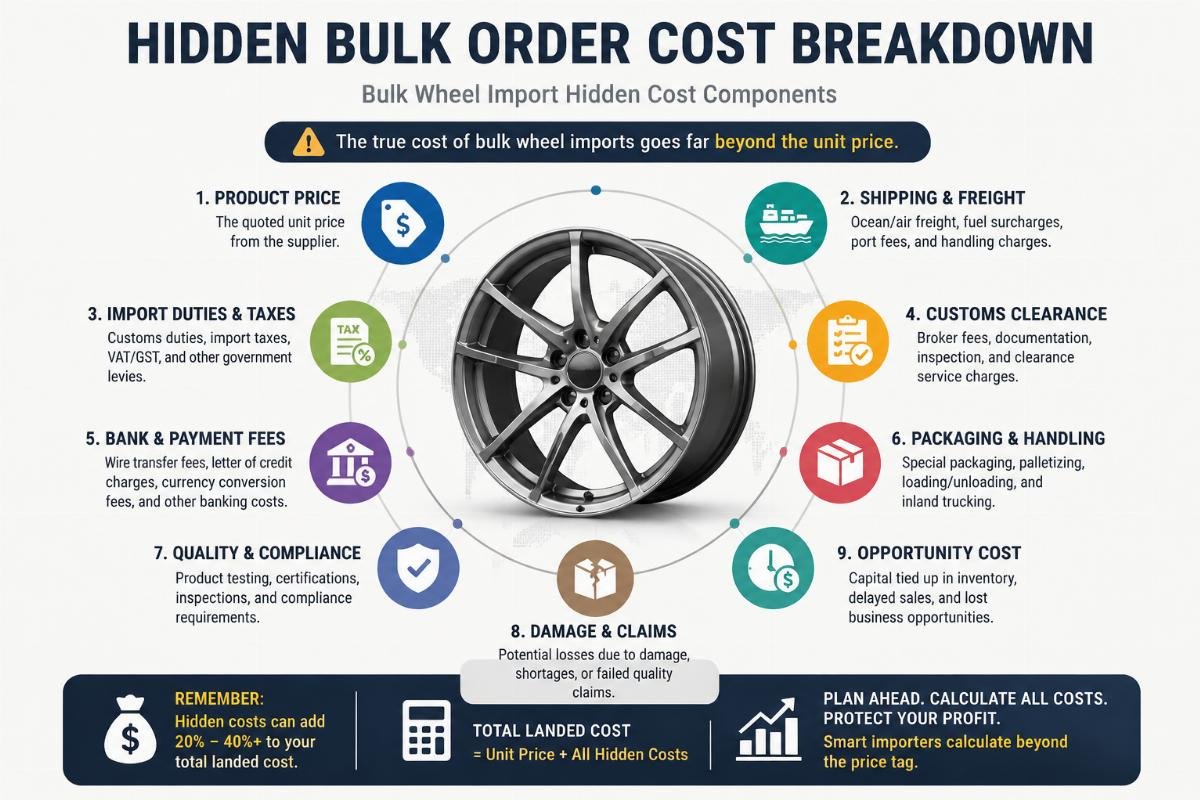
How do hidden costs erase bulk order savings for most importers?
Unaccounted rework fees, delayed shipping surcharges and non-compliant certification costs can eat up 15-25% of expected bulk savings if left unaddressed. Many buyers focus exclusively on quoted per-unit pricing and ignore these downstream costs, leading to total cost of ownership that is actually higher than a smaller, lower-risk order from a more reliable supplier.
| Hidden Cost Risk | Common Unmanaged Outcome | Proactive Mitigation Step |
|---|---|---|
| Rework Fees | 10-15% of units require post-delivery modification at buyer cost | Lock in zero-cost rework terms for non-conforming units in the original quote |
| Shipping Surcharges | Peak season congestion adds 8-12% to projected logistics costs | Confirm fixed all-in shipping rates in your order contract |
| Certification Rejections | Non-compliant units require full re-manufacturing at 2x original cost | Pre-confirm all required regional certifications before production starts |
A 2024 industry analysis of bulk wheel import orders found that 62% of buyers who only compared quoted per-unit pricing ended up paying 18% more on total cost of ownership due to unplanned hidden costs [NEED_CITE: 62% of bulk wheel importers face 15-25% unplanned cost overruns on large volume orders]. We have supported clients that avoided these losses entirely by auditing all cost components before committing to any large order.
- Total Cost of Ownership Calculation – Compare quotes across unit price, shipping, certification, warranty and rework costs rather than only the listed per-unit price.
- Fixed Rate Lock-In – Confirm all logistics and production costs as fixed line items in your contract to avoid unexpected surcharges.
- Pre-Production Certification Check – Submit all required regional compliance standards to the supplier before production starts to eliminate rejection risk.
What terms guarantee consistent bulk pricing across long-term orders?
Locking in annual volume framework agreements and fixed raw material index clauses prevents unexpected price fluctuations that erode long term savings. Many buyers assume that once they agree to a bulk order price, it will stay consistent for the full contract term, but unplanned spikes in aluminum pricing or facility overhead can push costs up mid-production if those terms are not explicitly written into the agreement.
A Southeast Asian auto manufacturer recently structured
